Key Takeaways
- Trust is no longer a “brand value.” It’s a measurable driver of growth, resilience, and valuation.
- The most dangerous trust failures don’t come from scandals; they come from inconsistency and overexposure.
- As skepticism rises, brands must work harder (and spend more) just to stand still.
- The next wave of market leaders will win not by saying more, but by saying less, better, and with conviction.
Something Strange Is Happening in the Market
On paper, marketing has never looked stronger. Brands are louder than ever. Content calendars are full. Executives are visible. Campaigns are polished. Metrics are being met.
And yet, confidence is slipping.
Customers hesitate longer. Deals take more touches. Reputation feels fragile, even for brands doing “everything right.”
This isn’t a downturn in creativity or technology. It’s a trust recession. And most companies are underestimating how deeply it’s shaping buying behavior, media influence, and long-term growth.

As the 2025 Edelman Trust Barometer underscores, trust in business leaders and corporate communication is weak, with public skepticism increasing toward whether leaders act with honesty and integrity.
Trust Is Becoming Scarce and Scarcity Drives Value
When something becomes scarce, it becomes expensive. Low-trust environments increase:
- Cost of customer acquisition
- Length of sales cycles
- Dependence on paid media
- Risk during moments of crisis
High-trust brands, on the other hand, move faster. They recover faster. They convert faster.
Research from Deloitte shows that companies perceived as highly trustworthy can outperform their peers in market value by up to four times, underscoring that trust is not “soft,” it’s strategic leverage.
How Brands Are Accidentally Burning Trust
Here’s the uncomfortable truth: Most trust erosion is self-inflicted. Not through scandals, but through noise.
We see it when brands:
- Chase every new narrative without reinforcing a core belief
- Rebrand before they’ve earned recognition
- Flood channels with content that sounds good but says nothing
- Put leaders everywhere without giving them anything meaningful to stand for
From the outside, it looks like momentum. From the audience’s perspective, it feels like confusion. And confusion is the enemy of trust.
The Big Aha: Visibility Without Credibility Is a Tax
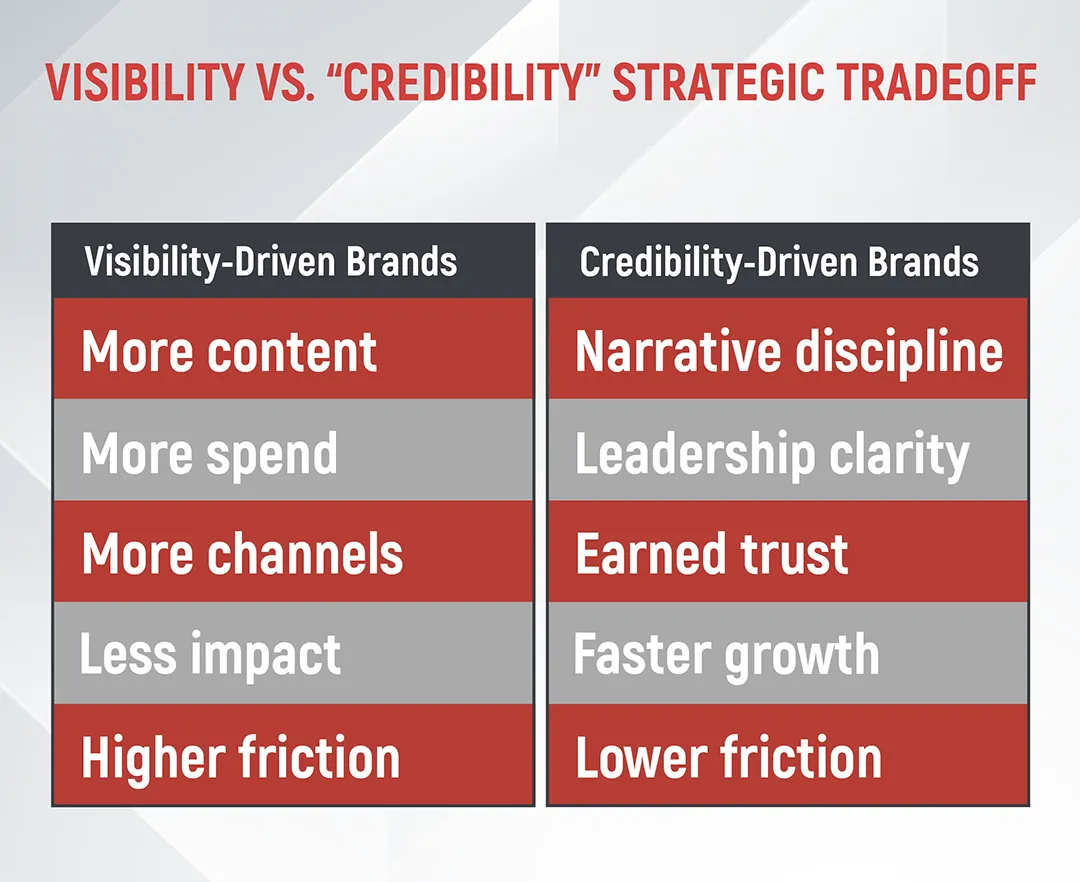
For years, marketing rewarded visibility at all costs. If you were everywhere, you were winning. But that doesn’t fly today; today’s buyers don’t reward presence. They reward coherence.
They ask:
- Do you sound the same quarter after quarter?
- Do your leaders reinforce, or contradict, your positioning?
- Does your behavior match your messaging when it actually matters?
When the answer is no, trust declines, and the brand pays a tax: More spend. More effort. Less impact.
Why Polished Messaging Is Losing Power
Trust Isn’t Claimed. It’s Constructed. One of the most common mistakes brands make when trust feels fragile is trying to declare it.
They say they’re transparent.
They say they’re authentic.
They say they’re trustworthy.
But trust doesn’t work that way. The most credible brands don’t ask audiences to trust them. They don’t even talk about trust explicitly. Instead, they design for it, through consistency, clarity, and behavior over time.
Trust is built when brands:
- Show up the same way, quarter after quarter
- Let actions reinforce messages, not replace them
- Resist the urge to over-explain or over-correct
- Allow credibility to be earned externally, not asserted internally
This is what real trust architecture looks like. It’s not a campaign or a positioning statement. It’s the cumulative effect of decisions made repeatedly…and visibly…over time.
When brands stop asking for trust and start operating in a way that earns it, skepticism softens. Friction decreases. Growth accelerates.
Not because they said the right thing—but because they proved it.
Ironically, as brands become more refined, audiences become more suspicious. Over-produced, hyper-optimized messaging now signals caution, not confidence. It feels engineered rather than earned.
What’s breaking through instead?
- Clear points of view
- Leaders willing to say fewer things, more clearly
- Messaging that evolves slowly and intentionally
- Earned media that validates credibility externally
The brands rebuilding trust aren’t perfect. They’re consistent.
Strategy in 2026: Conviction Over Coverage
This is the strategic shift most leadership teams haven’t fully made yet:
Trust doesn’t grow from activity. It grows from restraint.
The strongest brands right now are:
- Saying no to unnecessary visibility
- Protecting their narrative with discipline
- Aligning leadership, marketing, and operations tightly
- Letting credibility compound over time
They understand that every message either reinforces belief or weakens it. There is no neutral.
The Bottom Line
Trust has quietly become one of the most undervalued assets on the balance sheet, and one of the most powerful when leveraged correctly.
In a skeptical market, credibility accelerates everything:
- Growth
- Influence
- Recovery
- Longevity
This is the strategic choice leaders face in 2026:
You can chase attention, spending more, saying more, and working harder just to stay visible.
Or you can build trust deliberately…through clarity, consistency, and conviction…and let credibility do the heavy lifting.
The brands that treat trust as a strategic priority, not a communications afterthought, will lead the next decade.
Everyone else will keep chasing attention and wondering why it never quite moves the needle.