

Key Takeaways
- Marketing hasn’t lost its capability; it has lost its conviction.
- Risk aversion is quietly eroding influence, differentiation, and leadership credibility.
- Brands don’t lose relevance by making bold moves; they lose it by sounding like everyone else.
- In uncertain markets, confidence isn’t bravado; it is strategic clarity sustained over time.
Something Subtle…and Costly…is Happening in Marketing
On the surface, marketing looks disciplined. Budgets are carefully managed. Messages are tested and refined. Leadership visibility is planned, measured, and optimized. Nothing feels reckless. Everything feels controlled.
And yet, what I am sensing is a growing gap between effort and impact.
Brands are present, but not persuasive. Visible, but not influential. Active, but rarely shaping the conversation.
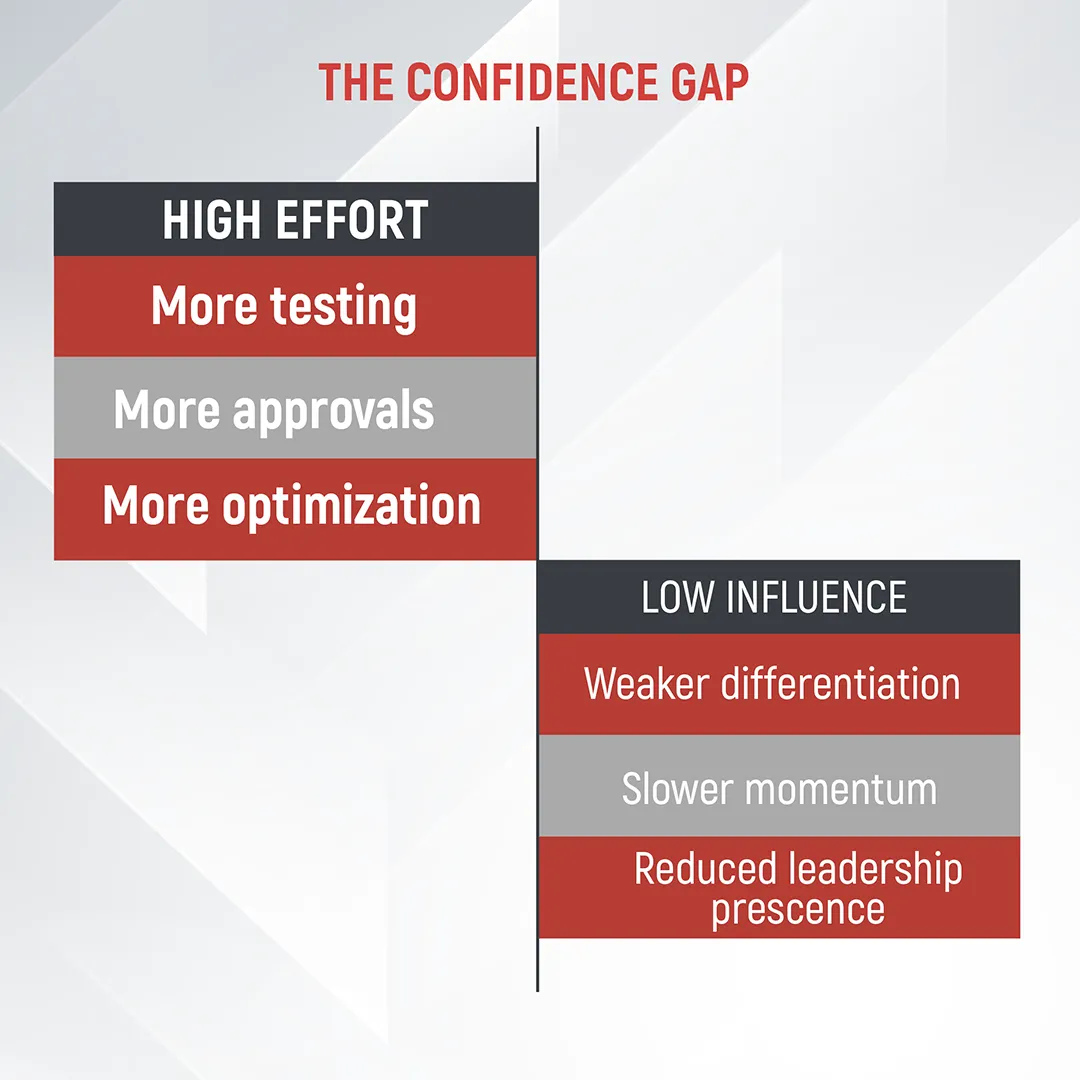
This isn’t because marketing teams lack talent, tools, or data. It’s because something harder to measure has been quietly dialed down: confidence.
When Caution Becomes the Strategy
In volatile markets, caution feels responsible. It signals prudence. It reassures stakeholders. It reduces the chance of missteps. But over time, caution can become the strategy itself.
Messages get softened to avoid friction. Points of view are rounded off to ensure alignment. Language is chosen not for clarity, but for safety. The result is marketing that is technically sound, but what I can only call, strategically timid.
Nothing is wrong with it. But nothing is particularly right about it either. And in crowded markets, neutrality doesn’t feel safe. It feels forgettable.
The Hidden Cost of Playing It Safe
Here’s the paradox many leadership teams miss: The more brands try to reduce risk, the more influence they quietly give up.
Influence requires leadership. Leadership requires belief. And belief requires the willingness to stand somewhere specific.
McKinsey research shows that fewer than one in four companies consistently outpace their industry peers on both revenue and profit growth, and those that do tend to pursue bolder strategies rather than default to caution, illustrating that risk aversion can hinder long-term influence and performance. Here’s what I know to be true: confidence compounds, hesitation dilutes.
The Big Aha: Influence Isn’t Earned Through Precision Alone
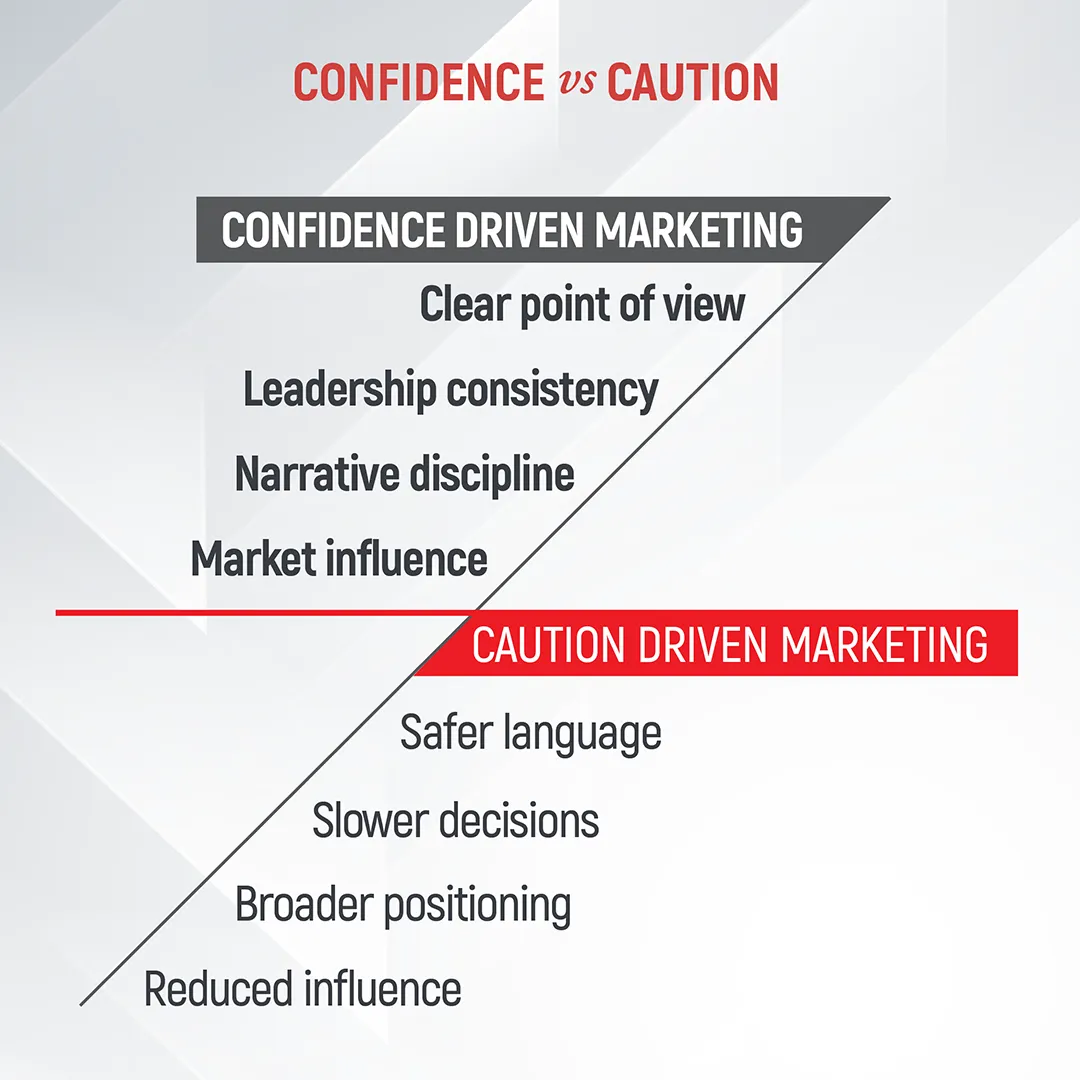
For years, marketing has been trained to optimize, to test, refine, and improve. Precision matters. But precision without perspective doesn’t create leadership.
Influence doesn’t come from having the right answer. It comes from having a clear one, and staying with it long enough for the market to believe you mean it.
The brands leaders listen to aren’t the ones with the most polished language. They’re the ones that demonstrate judgment. They sound the same quarter after quarter. Their leaders reinforce the narrative rather than reinterpret it. Their presence feels intentional, not reactive.
Confidence, in this sense, isn’t loud. It’s steady.
Why Consensus Is Flattening Brand Voices
One of the quiet confidence killers in modern marketing is over-alignment.
As more stakeholders weigh in, messages become safer…and frankly, thinner. Strong ideas get negotiated into generalities. Language is approved but rarely believed.
Collaboration is essential. But when consensus becomes the goal, conviction disappears.
The most influential brands right now aren’t the ones with the loudest voices. They’re the ones with the clearest point of view, and the discipline to protect it.
What Confident Marketing Actually Looks Like
Confident marketing doesn’t chase attention. It earns it.
- It’s comfortable saying fewer things and repeating them consistently.
- It allows leaders to speak with perspective, not permission.
- It understands that silence can be strategic when there’s nothing meaningful to add.
Most importantly, it trusts that clarity builds credibility, and credibility builds influence.
In Conclusion
Marketing doesn’t have a performance problem. It has a confidence problem.
And until brands are willing to stand for something clearly, consistently, and publicly, they will continue to spend more energy achieving less influence. In uncertain markets, confidence isn’t a risk. It’s the foundation of leadership.