By Lori Jones, President & CEO, Avocet Communications
Key Takeaways
- Trust…not awareness…is now the most decisive competitive advantage.
- Leaders must shift from message distribution to credibility system design.
- Trust has measurable velocity and consistency, shaping revenue outcomes.
- Brands that build structures of truth will outperform those chasing impressions.
Here is something that I believe very strongly in: premium brands never say “trust us.” They earn trust through performance, consistency, and the countless proof points that speak louder than any marketing claim ever could. And that’s exactly why this moment in time feels so profound, because the currency they’ve always relied on is now the currency every brand must master.
I’ve spent my entire career watching how markets shift, how customers evolve, and how brands respond. But the shift we’re witnessing now is different. It isn’t a trend or a cycle. It’s a fundamental rewiring of how decisions are made, a world where trust has moved from a differentiator to a decisive competitive advantage.
Edelman’s data shows this clearly: 64% of consumers prioritize trust as their top buying criterion, yet only 28% believe brands are honest. The gap between what consumers expect and what brands deliver has become the new battleground for competitive advantage.
THE MOMENT EVERYTHING SHIFTED
Last fall, I sat with a CMO whose metrics looked perfect…high reach, strong recognition, constant content output. But their pipeline had slowed, and competitors were suddenly gaining ground.
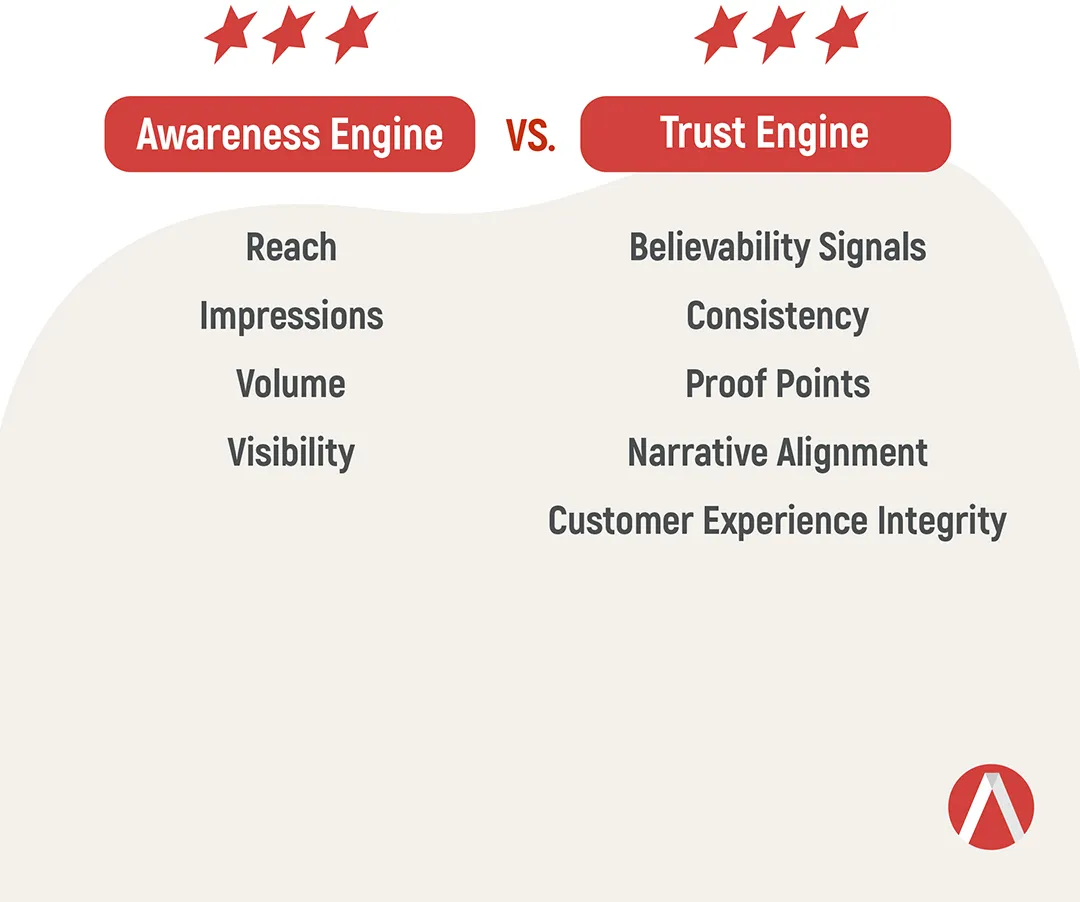
The issue wasn’t visibility. It was believability.
Their messaging didn’t match the customer experience. Content felt efficient but hollow. Teams were telling different versions of the story. The brand was present but not trusted.
So, I asked the question most leaders overlook: “Do your customers believe you?”
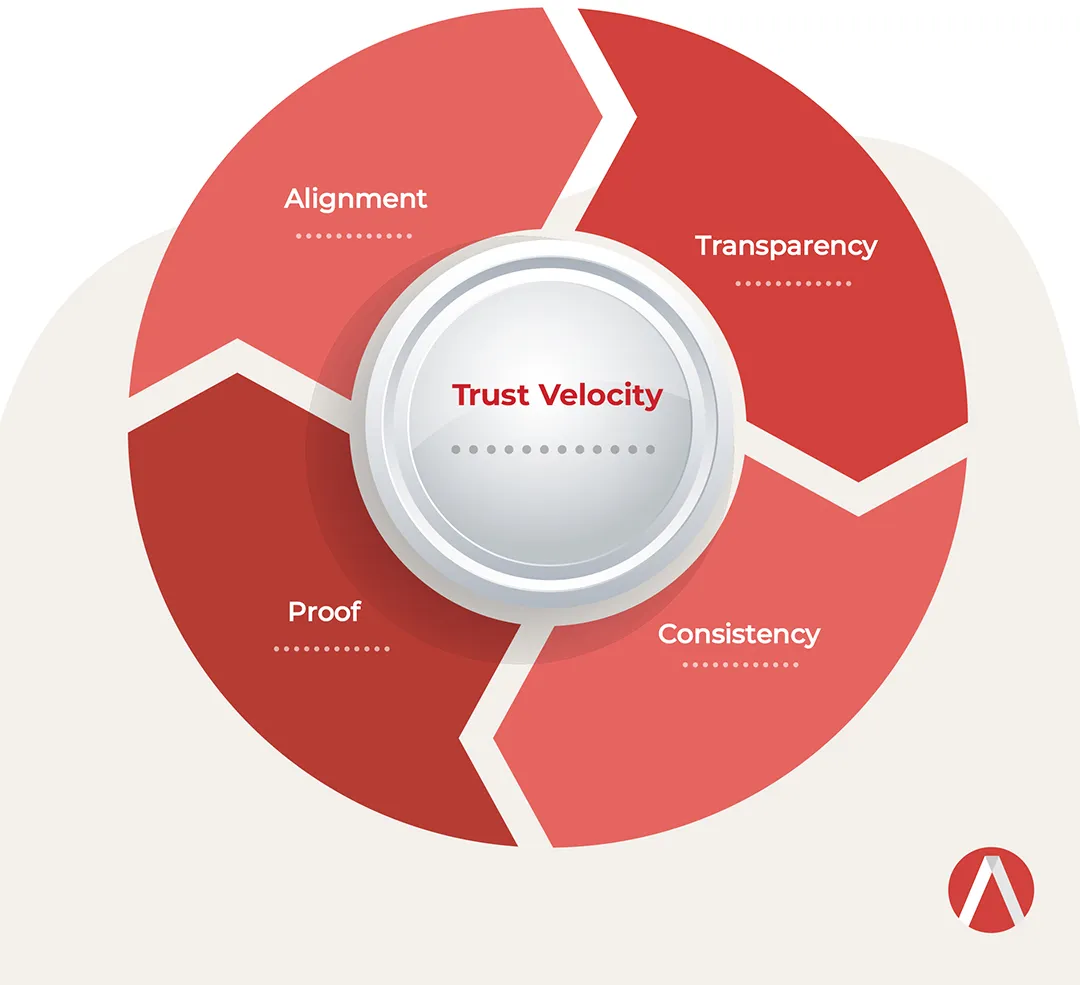
That silence in the room was the beginning of clarity: The next frontier of brand performance isn’t reach. It’s trust velocity, how quickly belief forms, spreads, and reinforces itself across every touchpoint.
TRUST IS THE NEW ECONOMIC ENGINE
Across sectors, the pattern is unmistakable:
- Trust accelerates decisions. Buyers move faster when they believe a brand.
- Trust drives loyalty. Edelman reports that trusted brands maintain loyalty even against lower-priced competitors.
- Trust lowers acquisition costs. Advocacy from believers outperforms any paid channel.
- Trust strengthens internal alignment. When leaders communicate transparently, employee advocacy rises, and brand consistency stabilizes.
Trust isn’t soft. It’s structural. It’s measurable. And it’s shaping revenue in real time.
AI HAS CHANGED THE TRUST EQUATION
Consumers aren’t just asking whether a message is relevant. They’re asking:
- Is it real?
- Was it written by someone who understands me?
- Does the brand stand behind this claim?
- Do their actions match their words?
The brands thriving today aren’t flawless; they’re transparent.
They show their work. They explain their reasoning. They open doors instead of hiding processes.
This isn’t about disclaimers. It’s about credibility architecture, the systems, behaviors, and signals that make belief possible.
THE BRANDS THAT WIN ARE BUILDING STRUCTURES, NOT STORIES
Every brand tells a story. Far fewer build the infrastructure to support it. The brands emerging as leaders are those that:
- Build truth platforms, not just marketing channels.
- Back claims with evidence, not polish.
- Align narrative with lived experience, from sales to service to culture.
- Operationalize trust across RevOps, CX, and leadership.
- Prioritize coherence over content volume.
This alignment…story + behavior + experience…creates gravitational pull in the marketplace.
A PATTERN ACROSS INDUSTRIES
Across manufacturing, tech, retail, and services, I see the same insight emerge: brands trying to “reinvent” themselves are often overlooking what actually differentiates them. Their strongest asset isn’t something new. It’s something enduring.
It’s years of credibility. Proven reliability. Consistency in a volatile world.
When brands lead with that truth…and support it with data, real stories, and transparency…perception shifts. They stop feeling outdated and start feeling stabilizing. Familiar. Trustworthy.
And when trust sits at the center of the narrative, something powerful happens: Prospects enter conversations already feeling connected. Sales cycles shorten. Engagement deepens.
That is trust working as a performance asset, something awareness alone can never achieve.
THE C-SUITE SHIFT IS UNDERWAY
Executives are beginning to ask new questions:
- What truly signals credibility?
- Where might we unknowingly be eroding trust?
- How consistent is our narrative across departments?
- Do our AI systems reinforce our values, or undermine them?
- How quickly does trust move through our buyer’s journey?
Soon, trust velocity will sit alongside Customer Acquisition Cost, Lifetime Value, and Net Promoter Scores as a foundational performance metric.
This is where modern leaders will differentiate. This is where brands will win; quietly, steadily, definitively.
FOOD FOR THOUGHT
- If trust became your primary KPI, what would change tomorrow?
- Where in your narrative do you rely on assumptions instead of proof?
- Which touchpoints build belief, and which weaken it?
- How aligned is your organization around a single coherent truth?
- Where are the hidden “trust leaks” in your brand ecosystem?
READY TO BUILD A BRAND PEOPLE BELIEVE IN?
If you want to explore what a trust architecture could unlock for your organization, let’s talk.
Contact Avocet Communications to start the conversation. Follow me on LinkedIn for more thought leadership and strategic insights.