

Key Takeaways
- Strategy hasn’t become less important; it’s become more dynamic.
- Long-range plans still matter, but they’re no longer sufficient on their own.
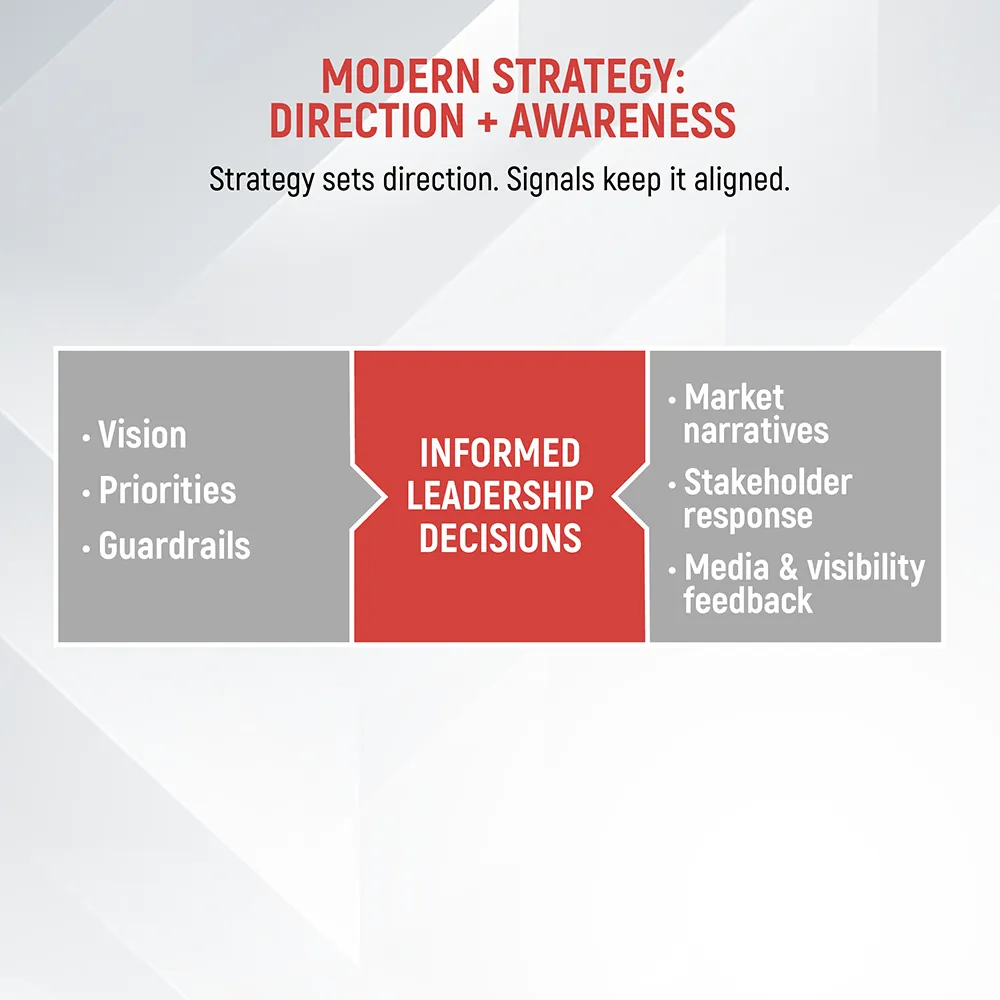
- The most effective leaders pair clear strategic direction with signal awareness.
- PR, communications, and leadership visibility increasingly function as early-warning systems, not just messaging tools.
Strategy Isn’t Broken. The Environment Changed.
Most leadership teams place a high value on strategy, and for good reason.
I’ve spent decades sitting in planning rooms with executives who take strategy seriously. Annual planning creates alignment, sets priorities, and establishes the guardrails that help organizations grow with intention. When done well, it brings clarity and focus that teams rely on all year long.
What I’ve noticed isn’t a loss of confidence in strategy, but a growing awareness that the environment around it is moving faster. In recent years, that acceleration has become impossible to ignore; decision cycles are shorter, narratives form faster, and external perception can shift well before internal plans have time to catch up.
Between planning cycles, markets evolve. Narratives take shape in real time. External forces…economic, cultural, regulatory…shift how decisions are received and interpreted. Leaders often sense these changes before they show up in reports or dashboards.
In those moments, strategy doesn’t fail; it waits. And the leaders who stay ahead are the ones who stay attentive to what’s happening beyond the room, using that awareness to reinforce, refine, or recalibrate their strategic direction as needed.
Why Static Strategies Struggle in Dynamic Markets
Traditional planning assumes a relatively stable environment. It relies on forecasts, assumptions, and scenarios that hold long enough to guide decision-making. Today, those assumptions are tested constantly.
Customer expectations evolve mid-year. Competitive positioning changes quickly. Media narratives emerge before leadership teams have time to react. Signals surface in public long before they appear in reports.
When strategies remain static while the environment shifts, organizations don’t fail outright, but they lose responsiveness. They become slower to adapt, slower to decide, and slower to lead.
What’s needed isn’t less strategy. It’s a more responsive relationship to it.
A Subtle Shift: Strategy as Direction, Not Prediction
Increasingly, the most effective leaders treat strategy less as a fixed roadmap and more as a directional framework.
The plan still matters. The vision still matters. The long-term ambition still matters.
What changes is how leaders listen between planning cycles. Instead of asking only, “Are we executing the plan?” They also ask, “What signals are telling us the context is changing?” That shift, from prediction to perception, is where modern strategy evolves.
What “Signals” Really Mean
Signals aren’t noise. And they aren’t trends for trend’s sake. They are early indicators that something meaningful is shifting:
- How the market is talking about a category
- What questions journalists are suddenly asking
- Where customers hesitate or lean in
- How leadership messages land, or don’t
These signals often appear first in public-facing arenas: media coverage, stakeholder conversations, leadership visibility, and narrative response. Long before they show up in dashboards.
The Role of PR, Communications, and Visibility Has Changed
In this context, communications isn’t just about amplification. It’s about awareness.
PR, leadership presence, and narrative alignment increasingly function as early-warning systems for the organization. They surface what’s resonating, what’s creating friction, and what’s shifting externally, often faster than traditional reporting mechanisms.
This doesn’t replace strategy. It informs it. And it requires leaders to pay attention not just to execution, but to how the strategy is being received, interpreted, and tested in the real world.
Leaders who pay attention to these signals don’t abandon their plans; they refine them. They adjust emphasis. They sense when to lean in and when to recalibrate. That’s strategic agility.

Planning Still Matters. Responsiveness Matters More.
The most resilient organizations don’t swing between rigid planning and constant reaction. They hold both.
They anchor themselves in clear strategic intent while remaining attentive to what the market is signaling in real time. They understand that leadership today requires both conviction and perception. Strategy becomes less about locking decisions in, and more about staying intelligently aligned.
The Bottom Line
Modern strategy hasn’t replaced planning. It has expanded it. In fast-moving markets, the leaders who stay ahead aren’t the ones with the most detailed decks. They’re the ones who pair strong strategic direction with the ability to read, and respond to, signals as they emerge.
Plans provide focus. Signals provide awareness. And together, they allow organizations not just to keep up, but to lead.