By Lori Jones, President & CEO, Avocet Communications
Key Takeaways
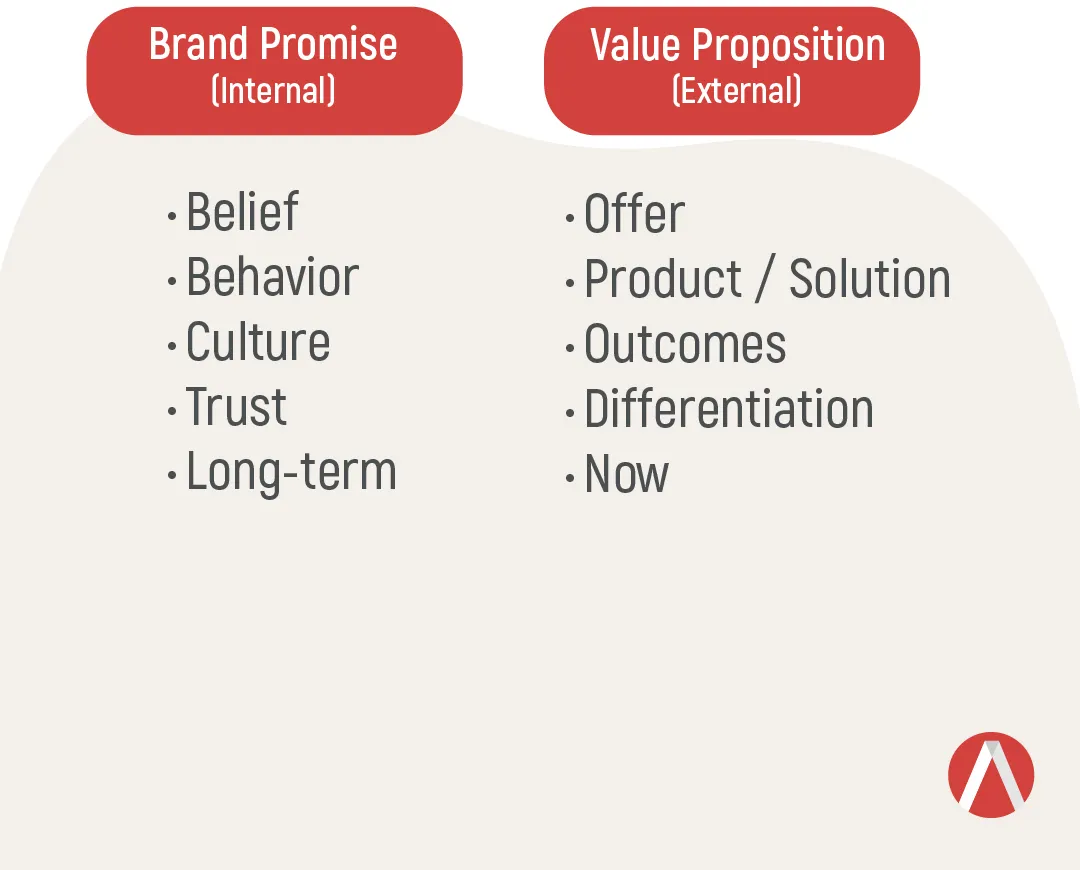
- Your brand promise is internal. It’s who you are, what you believe, and how you show up…everywhere.
- Your value proposition is external. It’s what you sell, how you solve problems, and why customers choose you.
- One fuels trust. The other drives transactions.
- When they’re aligned, brands scale. When they’re confused, brands stall.
- In a world of AI, automation, and sameness, promise is the differentiator no one can copy.
The Mistake I See Over and Over Again
Most leadership teams think they’re having a conversation about brand.
What they’re actually discussing is features, pricing, messaging, or positioning, in other words, their value proposition.
And while that matters, it’s not the thing customers stay loyal to.
Your value proposition answers: What do you do for me right now?
Your brand promise answers: Who are you, and can I trust you tomorrow?
Those are not the same conversation. Treating them as interchangeable is one of the most expensive brand mistakes organizations make.
Brand Promise: The Internal North Star
Your brand promise is not a tagline. It’s not a campaign. And it’s definitely not something marketing “owns.”
It’s the future-facing essence of your organization, the commitment you make to employees, customers, partners, and the market.
It shows up in:
- How decisions get made when no one is watching
- How leaders lead during uncertainty
- How employees behave when things go wrong
When teams are aligned and engaged, performance follows. Organizations with strong internal cohesion consistently see better outcomes, not just in productivity and profitability, but in their ability to grow and adapt over time.
If an organization in the professional services space wanted to position itself as deeply client-centric, its brand promise couldn’t live only in pitch decks or positioning statements. Externally, it may discuss partnership, responsiveness, and long-term relationships. Internally, however, that promise would need to show up in how teams are measured, how leaders prioritize work, and how success is defined. If internal incentives reward efficiency over outcomes, the promise erodes. If they reward problem-solving, trust compounds. In this scenario, the services themselves don’t change, but how consistently the promise is delivered does.
Value Proposition: The External Proof Point
Your value proposition is tangible. It’s specific. It’s measurable.
It answers:
- What problem do you solve?
- Why are you better?
- Why should I choose you now?
This is where products, solutions, pricing, and outcomes live.
But here’s the tension: Value propositions can be copied. Brand promises can’t.
Technology levels the playing field fast. AI accelerates it even faster. What differentiated you two years ago is table stakes today.
Which means your value proposition needs something deeper to stand on. That something is belief.
If an organization in the technology space wanted to gain rapid traction, it could lead with a compelling value proposition: speed, flexibility, or lower barriers to entry. Early momentum would be likely. But without a clearly defined brand promise guiding internal behavior and decision-making, growth would become harder to sustain. Teams would interpret priorities differently. Customers would experience inconsistency across touchpoints. The offer would remain strong, but trust would become fragile. The value proposition would open doors, while the absence of a promise would quietly limit what happens after.
Where the Real Magic Happens: Alignment
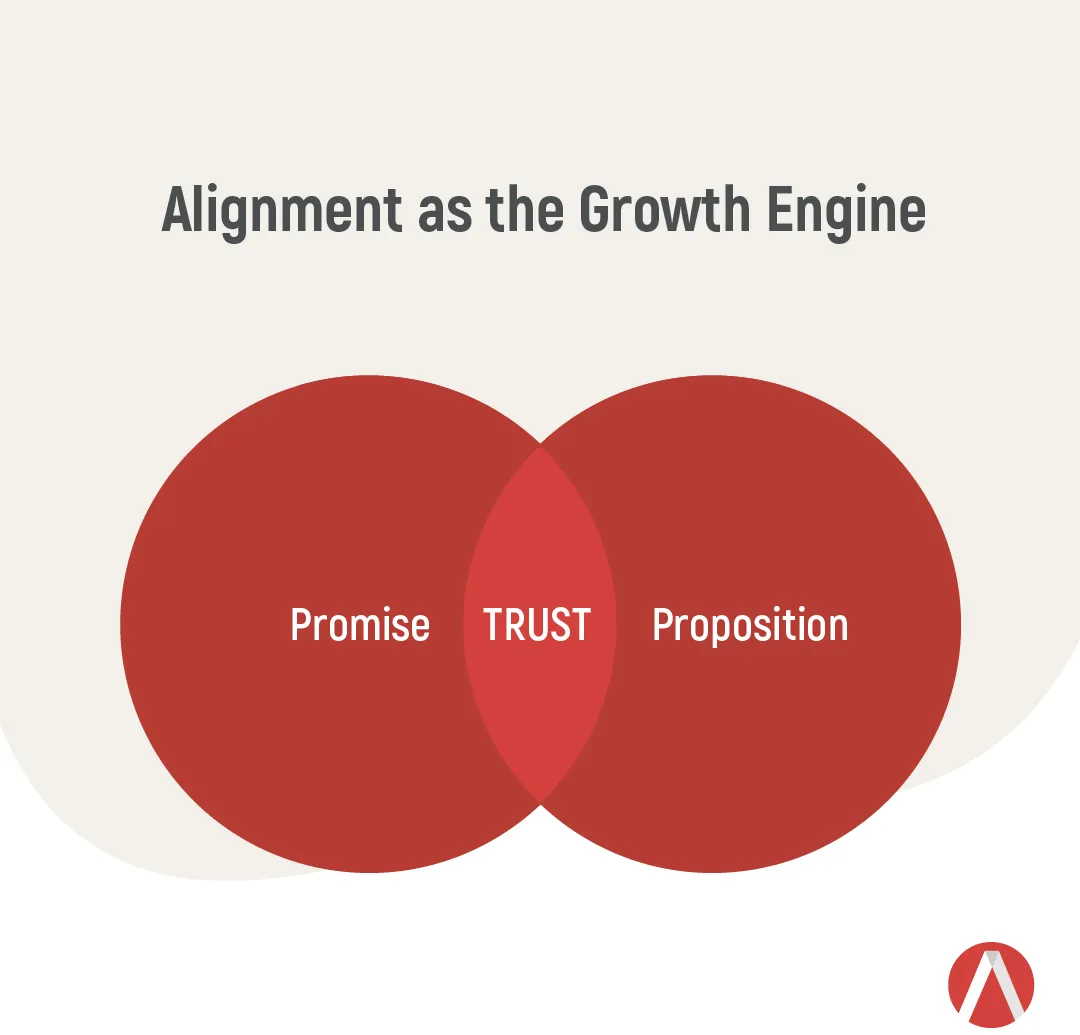
The most powerful brands don’t choose between promise and proposition.
They align them.
Your brand promise sets the standard. Your value proposition proves you can deliver.
In every industry, growth isn’t constrained by capability; it’s constrained by alignment.
Think about the brands you trust most.
You don’t just buy what they sell. You buy who they are.
And when those two things drift apart? Customers feel it immediately. So do employees. So does the market.
I’ve seen organizations with brilliant products struggle because their internal culture couldn’t support the promise they were making externally. I’ve also seen companies with modest offerings outperform competitors because their promise created loyalty no feature could replace.
The Future Belongs to Belief-Led Brands
We’re entering an era where:
- Customers are more skeptical
- Employees want meaning, not mission statements
- AI makes execution faster, but authenticity rarer
In this environment, your brand promise becomes your most strategic asset.
It’s the filter for innovation. The anchor during disruption. The reason customers stay when someone cheaper comes along.
Your value proposition may open the door. Your brand promise determines whether people walk through it—and stay.
Questions Every Leadership Team Should Be Asking
- Do our employees understand our promise, or just our priorities?
- Where does our external messaging overpromise what our internal culture can’t support?
- Are we optimizing for short-term conversion or long-term trust?
- Would our customers describe us the way we describe ourselves?
If those questions feel uncomfortable, you’re asking the right ones.
The Bottom Line
Your value proposition wins business. Your brand promise builds belief.
And belief is what drives growth when markets shift, competitors multiply, and attention becomes scarce.
A Final Thought, and an Invitation
At Avocet, we work with leadership teams who are ready to stop chasing differentiation and start defining it from the inside out.
If you’re ready to align who you are with what you sell, and turn trust into your strongest growth engine, I’d love to talk. Let’s build a brand that keeps its promise.