
Key Takeaways:
- The most significant competitive threats rarely come from inside your category.
- Cross-industry entrants often redefine customer expectations before incumbents react.
- Blind spots form when companies benchmark only against familiar players.
- Innovation today is about business model shifts, not just product improvements.
- Leaders who scan horizontally, not just vertically, move first.
When leadership teams talk about competitors, the list usually looks familiar.
Same industry. Same customer base. Same conferences. Same analyst reports.
We benchmark against companies that look like us.
And that’s exactly the problem. The next organization that disrupts your market may not resemble you at all.
The Comfort of Familiar Competition
Most competitive analysis is vertical.
We study direct rivals.
We track their pricing.
We watch their messaging.
We compare feature sets.
This feels disciplined. Responsible.
But it creates a dangerous blind spot.
When every company in a category benchmarks against one another, innovation becomes incremental.
Everyone optimizes. No one redefines. And disruption rarely enters through the front door.
Cross-Industry Entrants Redefine Expectations
The most disruptive competitors often import a model, experience, or pricing structure from another industry entirely. They don’t just compete differently. They compete on different terms.
They ask:
- Why does this process take this long?
- Why is pricing structured this way?
- Why is the customer experience fragmented?
- Why is this industry communicating like it’s 2012?
And suddenly, the rules shift. Not because incumbents lacked capability, but because they lacked perspective.
Your Real Competition Is Customer Expectation
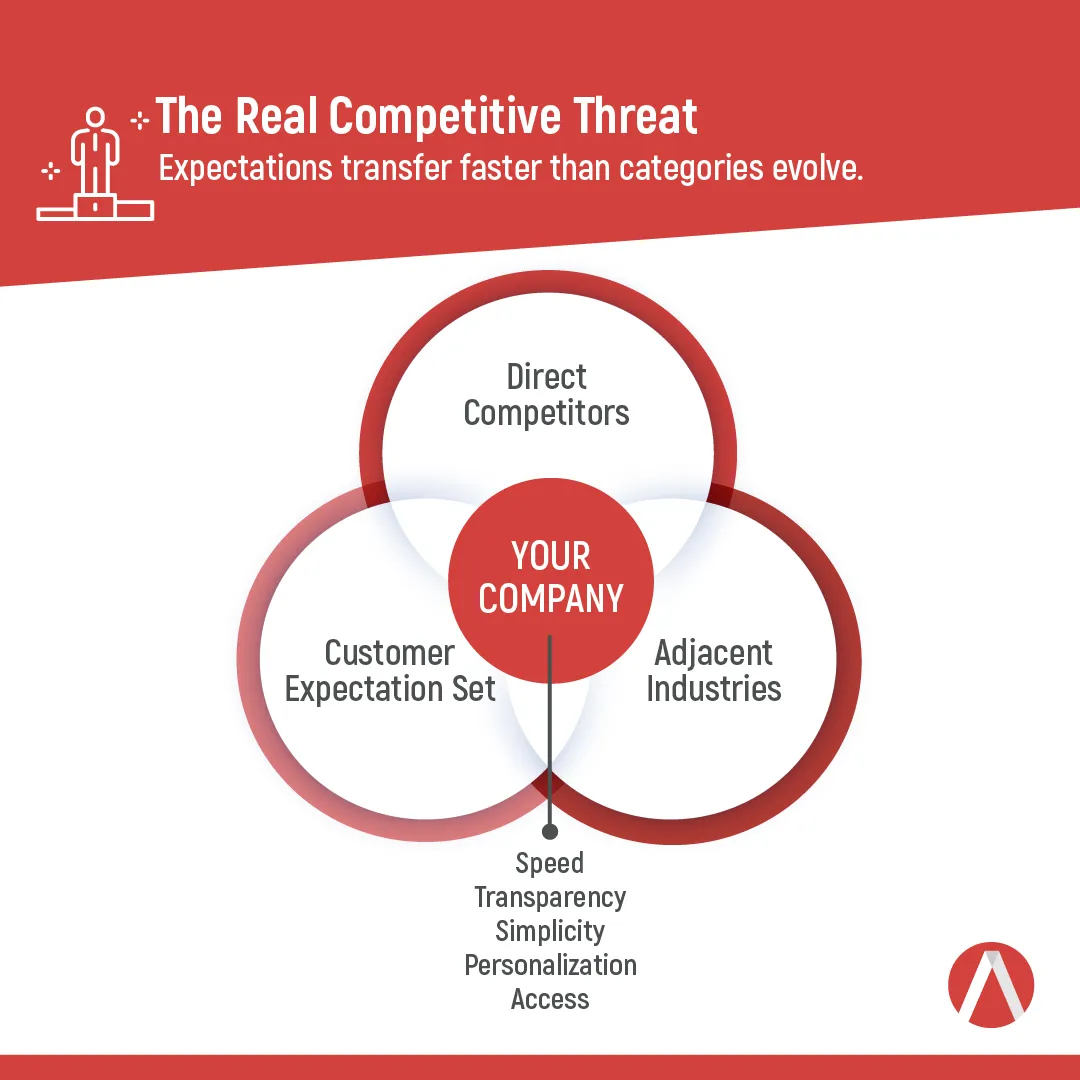
Customers do not benchmark you against your industry peers. They benchmark you against their best experiences.
The speed of Amazon.
The transparency of fintech.
The personalization of streaming platforms.
The ease of consumer-grade UX.
Expectations transfer across categories.
If your industry moves slowly but another teaches customers to expect immediacy, your category will feel outdated, even if your direct competitors operate the same way you do.
Comfort with industry norms is not protection. It’s vulnerability.
Business Model Disruption Is Harder to See
Many leaders focus on product differentiation. But the biggest shifts today are happening in:
- Pricing models
- Distribution channels
- Platform integration
- Data ownership
- Customer experience architecture
A competitor entering from outside your category may not beat you on features.
They may beat you on simplicity. On transparency. On speed. On access. And those variables compound.
The Executive Blind Spot
Here’s the uncomfortable truth: Blind spots don’t feel like risks. They feel like stability.
When revenue is steady and competitors are predictable, it’s easy to assume the market landscape is clear. But markets rarely announce disruption in advance. They shift gradually…until they shift suddenly.
The leaders who anticipate cross-industry disruption ask different questions:
- Who else could serve our customer differently?
- What adjacent industries are solving similar problems more efficiently?
- Where are expectations evolving faster than we are?
- What assumptions about our model have we stopped questioning?
That kind of thinking requires humility…and curiosity.
Horizontal Scanning as a Leadership Discipline
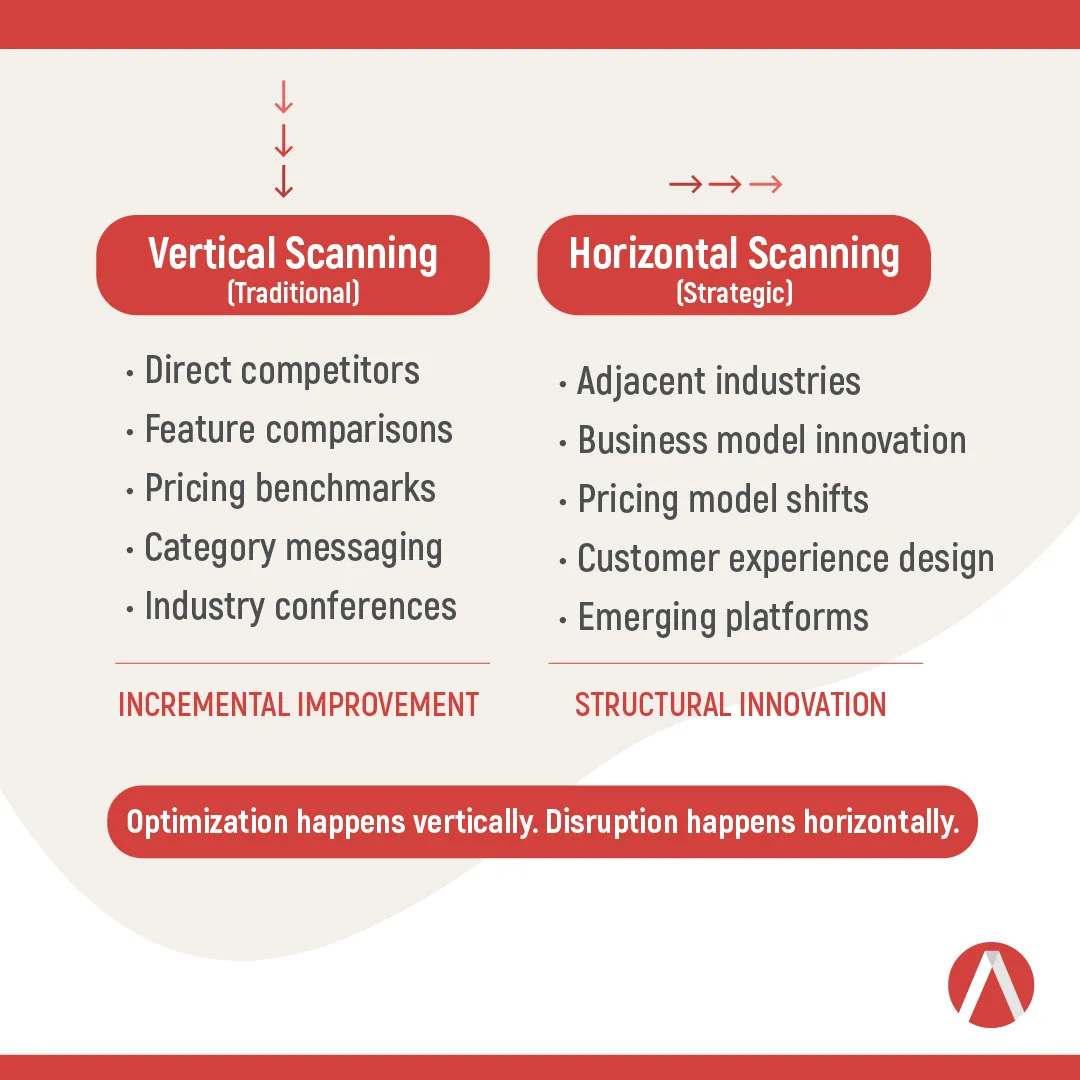
Strategic leaders do not only monitor vertical competitors. They scan horizontally.
They study industries adjacent to theirs.
They observe emerging pricing models.
They evaluate customer experience trends outside their space.
Because disruption rarely comes from the expected direction.
It comes from someone asking: “Why does it have to be done this way?” And then proving it doesn’t.
The Risk of Looking Inward
When companies focus exclusively on internal optimization (refining messaging, improving funnel metrics, tweaking campaigns) they can miss structural shifts happening around them.
Optimization makes you better. Perspective makes you relevant. The future rarely belongs to the most efficient operator. It belongs to the company that redefines the rules.
The question for leadership teams is not: “Who are our competitors?” It’s: “Who could become our competitor?”
Because your next threat may not look like you.
It may not talk like you. It may not even operate in your category…yet.
But if it reshapes customer expectations first, it will.
And by the time it looks familiar, it may already be ahead.