

Key Takeaways
- Companies that try to market to everyone often end up resonating with no one.
- Clear positioning and a defined ideal customer create stronger messaging and faster trust.
- The most successful brands start focused and expand from a position of strength.
- Differentiation requires clarity, even if it means not appealing to everyone.
- In crowded markets, precision beats scale.
For years, I’ve heard a phrase that always gives me pause: “We serve everyone.”
It usually appears early in a conversation about marketing strategy, often said with confidence and optimism. After all, the logic seems sound. If your product or service can help many types of customers, why limit the opportunity?
But in reality, that mindset often leads to one of the most common…and costly…marketing mistakes companies make.
Because when everyone is the customer, no one feels like the customer. And in today’s crowded marketplace, vague messaging doesn’t just weaken marketing. It makes brands invisible.
The “Everyone Problem”
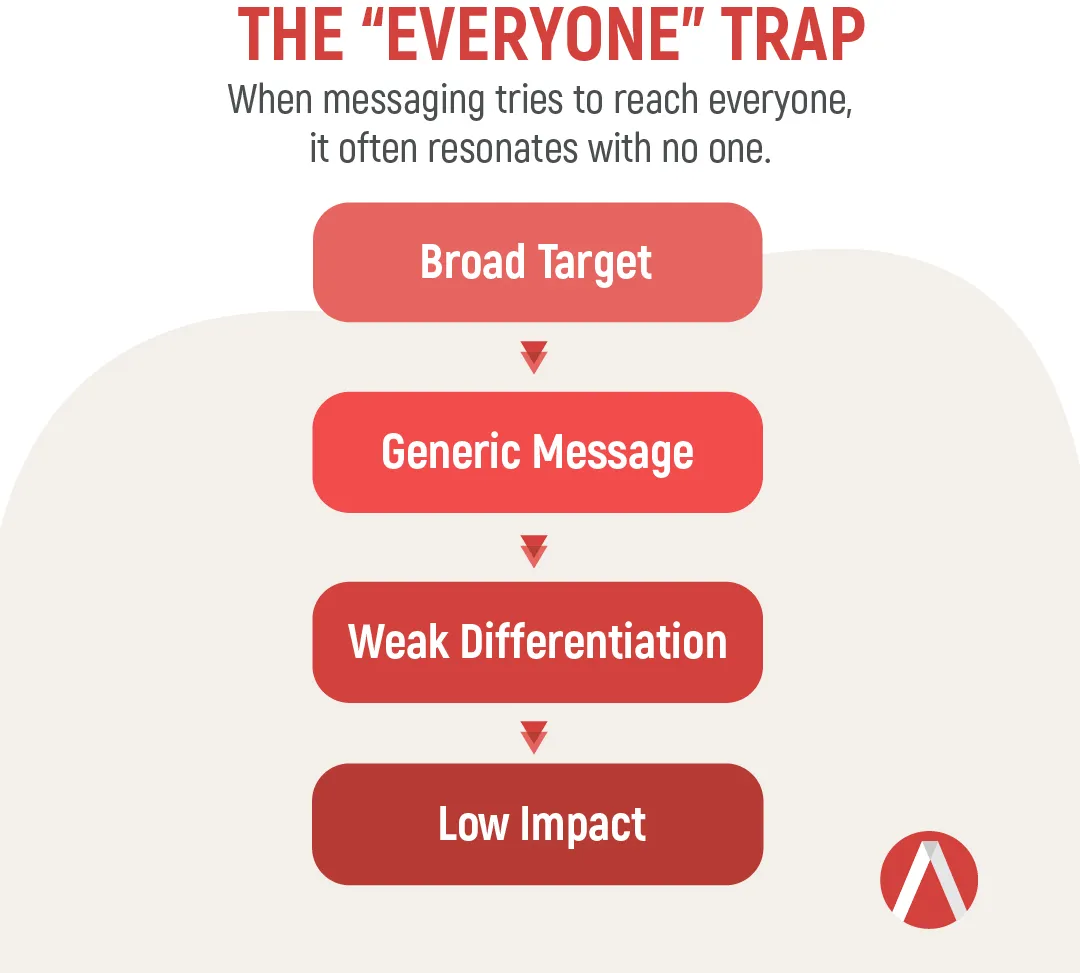
It’s easy to understand why companies fall into this trap. Why would a brand want to exclude potential buyers? Sales teams want as many opportunities as possible. Investors often push for larger addressable markets. But marketing doesn’t work the same way markets do.
Markets may be large. Messaging cannot be.
The broader a target audience becomes, the more generic messaging must become in order to accommodate it. Language softens. Specific insights disappear. Distinct perspectives fade.
What’s left is messaging that sounds safe but also sounds exactly like everyone else.
And when every company or product claims to be innovative, trustworthy, state-of-the-art, customer-focused, and results-driven, differentiation quietly disappears.
Why Focus Creates Power
The most influential companies rarely begin by trying to reach everyone. Instead, they focus.
Strong brands rarely begin by trying to appeal to everyone. Instead, they start with a clear point of view about who they serve, and just as importantly, who they don’t.
Take Apple. For decades, Apple positioned itself not as a computer company for everyone, but as a brand for people who value design, creativity, and simplicity. Its messaging, famously captured in the “Think Different” campaign, spoke directly to innovators, creators, and rule-breakers. That clarity helped Apple build one of the most distinctive brands in the world. Only later did its products become truly mainstream.
Patagonia offers another powerful example. The company has never tried to appeal to every outdoor consumer. Instead, it has positioned itself firmly around environmental activism and responsible consumption, even encouraging customers to buy fewer products through its “Don’t Buy This Jacket” campaign. By standing clearly for something, Patagonia has built extraordinary loyalty among customers who share its values.
In both cases, success didn’t come from broad appeal. It came from clarity of identity. These brands knew exactly who they were…and who they weren’t. And that clarity gave their messaging power. These companies didn’t succeed by starting broad. They succeeded by starting clear…and that clarity helped them define their value, sharpen their messaging, and build authority within a specific audience before expanding into new markets.
The Differentiation Trade-Off
Here’s the paradox. The more companies try to appeal to everyone, the more they begin to sound exactly the same.
Why? Because real differentiation requires something many organizations struggle with: the discipline…and the courage…to choose.
To say clearly, this is who we are. And just as importantly, this is who we are not.
But the truth is that strong brands are built on that kind of clarity. They emphasize particular strengths. They solve specific problems. They are not all things to all customers. They speak directly to a defined audience. In essence, they adopt a “we’re this, not that” approach to the market.
But that kind of focus requires confidence. It means resisting the temptation to soften the message in order to appeal to everyone. It means accepting that some audiences may decide the brand isn’t for them.
When companies try to accommodate every possible customer, those sharp edges begin to disappear.Bold ideas become softer language.
Distinct perspectives become generalized claims.
Positioning becomes polite instead of powerful.
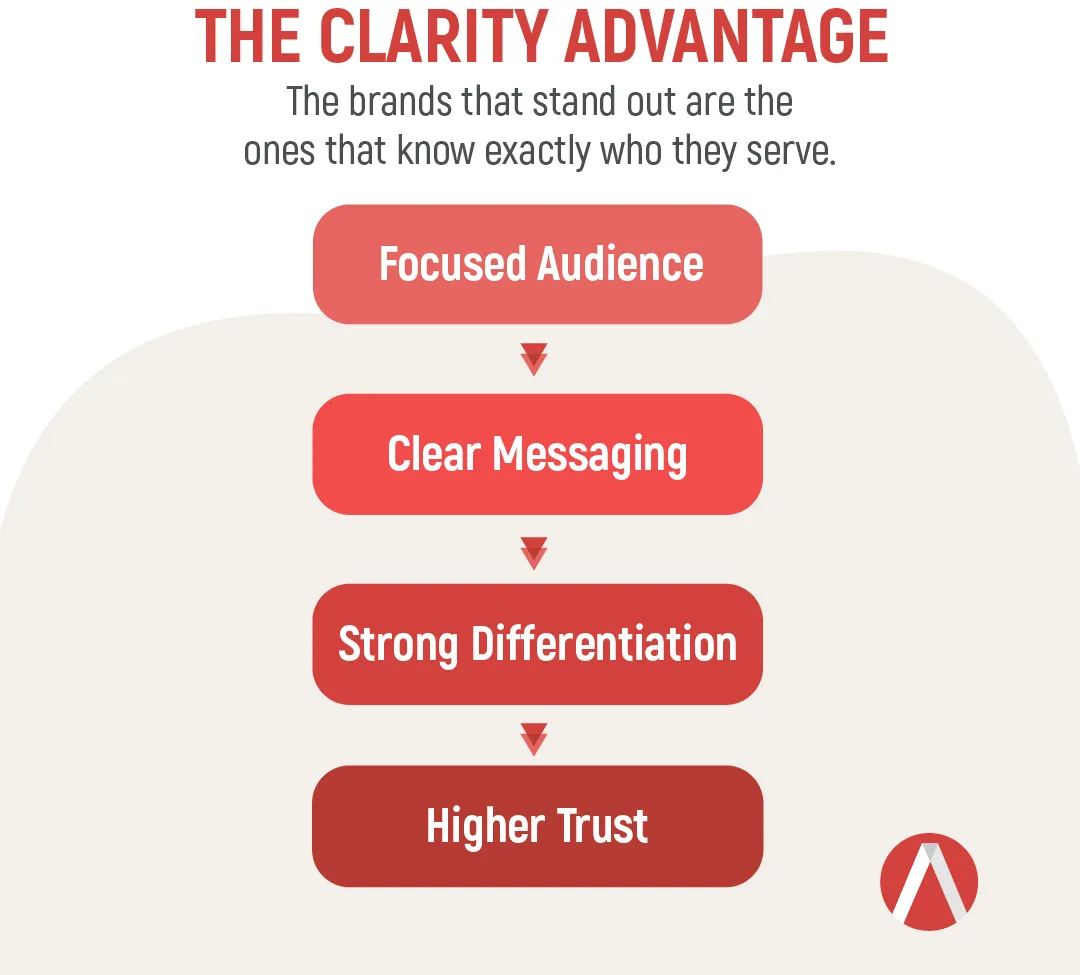
Great Brands Repel
This may sound counterintuitive, but strong brands often succeed because they aren’t for everyone.
They are clear about the problems they solve, the customers they serve best, and the perspective they bring to the market.
That clarity naturally attracts the right audience and repels the wrong one. And that’s not a weakness. It’s a strategic advantage.
Because the right customers recognize themselves in the message immediately. The brand feels relevant, credible, and confident in its expertise. And relevance is one of the most powerful drivers of marketing effectiveness.
Clarity Accelerates Growth
Focused companies tend to grow faster for a simple reason: clarity builds momentum. When organizations understand exactly who they serve best, several things begin to happen.
Messaging becomes sharper. Marketing becomes more efficient. Sales conversations become more relevant.
Most importantly, the market begins to associate the brand with a particular kind of expertise. Over time, that association builds reputation, and reputation compounds. Eventually, companies that begin with a focused audience often expand into broader markets, but they do so from a position of strength. Not because they tried to reach everyone. But because they first learned how to resonate deeply with the right people.