

Key Takeaways:
- Visibility does not automatically create authority or enterprise value.
- A personal brand that isn’t aligned to enterprise positioning can dilute both.
- Influence is measured by decision impact, not impressions.
- Narrative consistency across channels determines credibility.
- Strategic restraint often builds more authority than constant output.
I’ve watched a quiet shift happen in boardrooms over the last few years.
Executives are no longer asking, “Should I be visible?” They’re asking, “How often should I post?”
Podcasts. LinkedIn. Panels. Guest columns. Interviews.
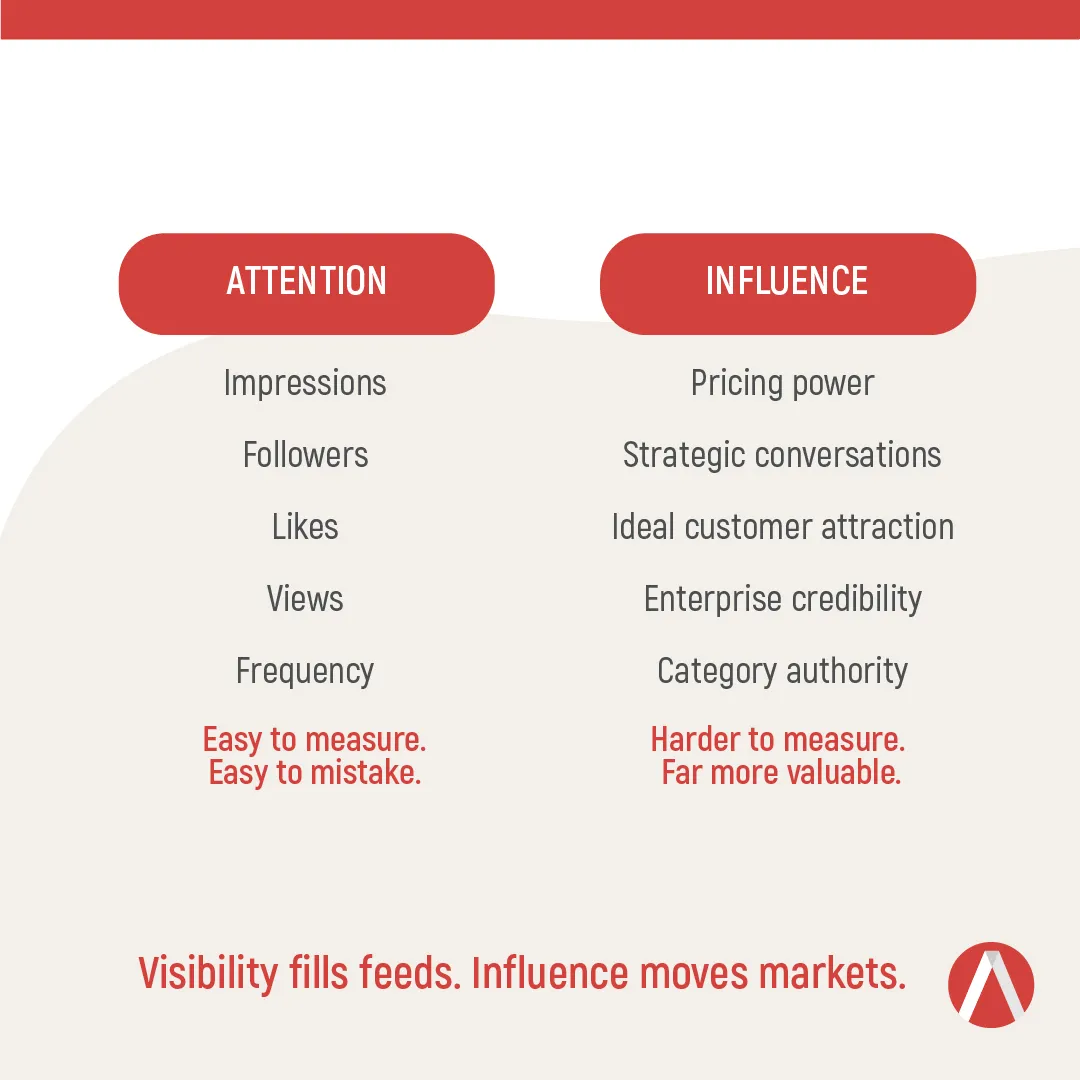
The pressure to be present is constant. And here’s the uncomfortable truth: Attention is easy to measure. Influence is not.
They are not the same thing.
The Visibility Explosion
We’re living in an era where executive presence is democratized. Anyone can publish. Anyone can record. Anyone can build a following.
But increased output does not automatically translate into increased authority. In fact, overexposure without alignment often creates the opposite effect: noise.
According to a Edelman–LinkedIn B2B Thought Leadership Impact Report, while many buyers engage with thought leadership content, fewer than half say it clearly demonstrates a vendor’s understanding of their business challenges, showing that most content is consumed but forgotten.
Visibility gets you seen. Authority gets you chosen.
Personal Brand vs. Enterprise Positioning
This is where leaders often blur lines.
A strong personal brand can elevate a company. But only when it reinforces the enterprise narrative. When executive visibility becomes detached from corporate positioning, three things happen:
- The company’s value proposition becomes diluted.
- The executive becomes the brand, instead of amplifying it.
- Market perception fragments across channels.
I’ve seen leaders build impressive personal followings that do little to strengthen enterprise differentiation.
Followers are not the same as influence in the buying cycle. If your visibility does not strengthen your company’s category position, it’s activity, not strategy.
When Thought Leadership Strengthens a Company
Executive visibility works when:
- It sharpens the company’s point of view.
- It reinforces differentiated positioning.
- It attracts the right customers, not just broad engagement.
- It supports recruiting, partnerships, and enterprise credibility.
In other words: when it ladders up to growth.
True influence shows up in different metrics:
- Higher-quality inbound.
- Shorter sales cycles.
- Increased pricing confidence.
- Stronger recruiting pipelines.
- Invitations into strategic conversations.
Influence moves markets. Attention fills feeds.
Narrative Consistency Is Authority
Here’s a question I often ask: If I reviewed your last 20 executive posts, interviews, and appearances, would I see a clear, repeatable thesis? Or a collection of loosely related ideas?
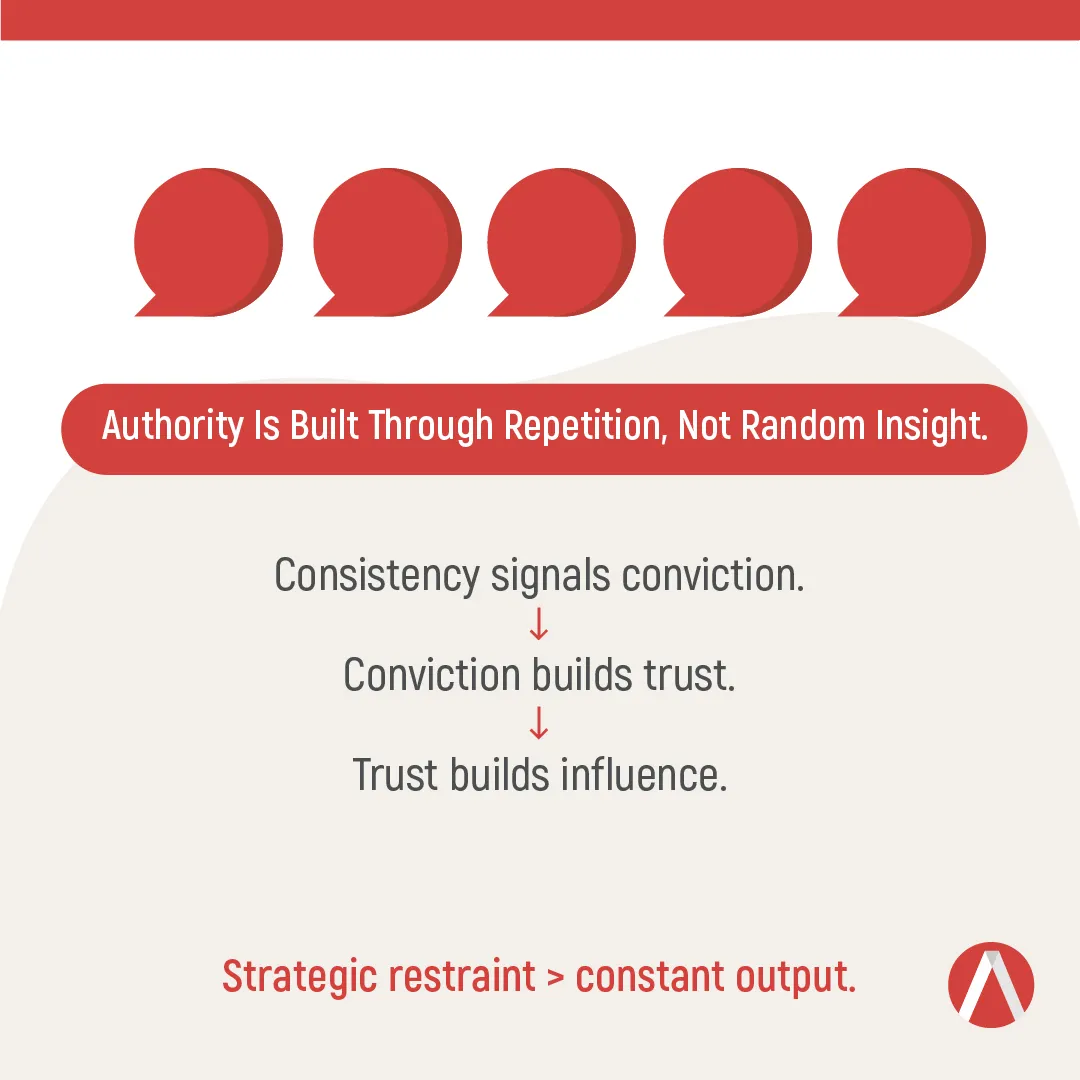
Authority is built through narrative repetition, not random insight.
The most influential leaders I know return to a defined set of themes. They reinforce a point of view. They shape a conversation over time.
Consistency signals conviction.
Conviction builds trust.
Trust builds influence.
Measuring Authority, Not Impressions
Impressions are seductive. So are follower counts. But enterprise influence should be measured differently.
Ask instead:
- Did this visibility create strategic conversations?
- Did it attract our ideal customer profile?
- Did it elevate our category authority?
- Did it align with our long-term growth narrative?
If visibility is not creating enterprise leverage, it’s marketing theater. And theater rarely builds enterprise value.
The Power of Strategic Restraint
One of the most counterintuitive truths in modern visibility: Sometimes saying less builds more authority.
When every leader posts daily commentary on every topic, differentiation disappears.
Strategic restraint…speaking when it reinforces your defined position…creates signal in a sea of noise.
Not frequency. Focus.
Not volume. Alignment.
Influence is rarely loud. It is consistent.
The Leadership Trap
The trap isn’t being visible. The trap is mistaking visibility for progress.
Boards don’t reward impressions. Markets don’t reward activity. Customers don’t buy frequency.
They buy confidence. They buy clarity. They buy conviction.
And conviction must be reflected not just in what leaders say, but in how it reinforces enterprise strategy.
The question I leave you with: Are you building attention? Or are you building authority?
Because in 2026, influence is not built through constant presence.
It is built through strategic alignment, across message, market, and mission.
And that is far harder to measure… and far more valuable to own.