
Key Takeaways:
- AI delivers the greatest value when integrated directly into marketing workflows rather than treated as a standalone tool.
- The speed from customer insight to campaign execution is shrinking dramatically, creating new opportunities for marketers to respond in real time.
- Human-led brand strategy remains the foundation of trust, authenticity, and differentiation.
- AI can accelerate personalization, localization, and execution, but it cannot replace strategic thinking.
- The marketers who thrive in the next era will be those who learn to orchestrate AI within their daily operations.
“If organizations think AI is a magic wand that is going to solve all their problems, it is not right.” Boobesh Ramadurai
Boobesh Ramadurai
What excited me most about my recent StrategyCast conversation with Boobesh Ramadurai of LatentView Analytics was that he brought something refreshingly practical to the AI conversation. As a strategic consulting partner to CMOs who is charged with future-proofing their organizations with the proper technology and AI-forward mindsets, I knew this was going to be a really juicy conversation.
Let’s be real for a moment. Most discussions about artificial intelligence today fall into one of two camps. Either AI is presented as the answer to every business challenge imaginable, or it’s treated as a looming threat poised to replace entire teams.
Boobesh offered a much more grounded perspective.
After spending decades helping organizations move from intuition-based decision making to data-driven marketing, and now into AI-enabled operations, he sees AI not as a replacement for marketers, but as an accelerator for marketers who understand how to use it well.
That distinction matters.
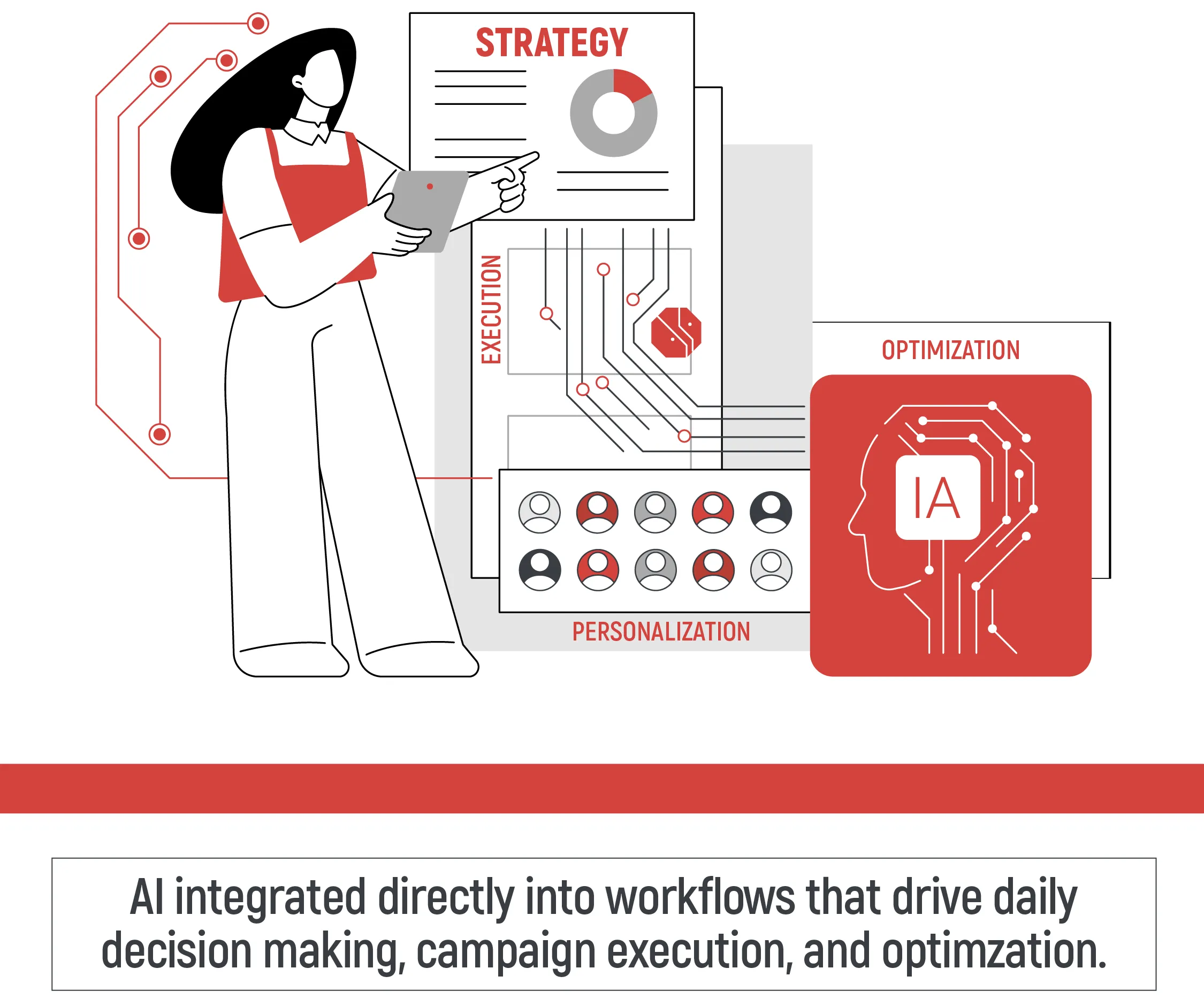
Because the organizations seeing real results from AI are not necessarily the ones with the most tools. They are the ones integrating AI directly into the workflows that drive daily decision-making, campaign execution, and customer engagement.
AI Is Not the Strategy. It Is Part of the System.
One of the strongest themes throughout our conversation was the difference between using AI as a tool versus integrating AI into a business process.
As Boobesh explained, “Only the organizations that integrate AI into their design workflow are able to see the value.”
This distinction may sound subtle, but it has enormous implications.
Many organizations have deployed AI tools. Far fewer have operationalized them.
The difference between the two is the difference between experimentation and transformation.
Instead of simply asking AI questions or generating content occasionally, leading organizations are embedding AI into campaign planning, content verification, personalization, localization, performance optimization, and customer intelligence workflows.
This allows marketers to move faster while maintaining consistency and control.

Cathy McPhillips
Cathy McPhillips , President of the Marketing Artificial Intelligence Institute, echoed this perspective during StrategyCast Episode 529 when she shared, “…now we can use some of these tools to help us with that strategy part to help us think alongside us, not replacing what we’re doing because you need to really critically think to use these tools the right way.”
The common thread is clear. AI works best when it enhances how marketers operate, not when it attempts to replace their judgment.
From Culture to Campaign at Unprecedented Speed
One of the most fascinating concepts Boobesh introduced was what he calls “culture to campaign.”
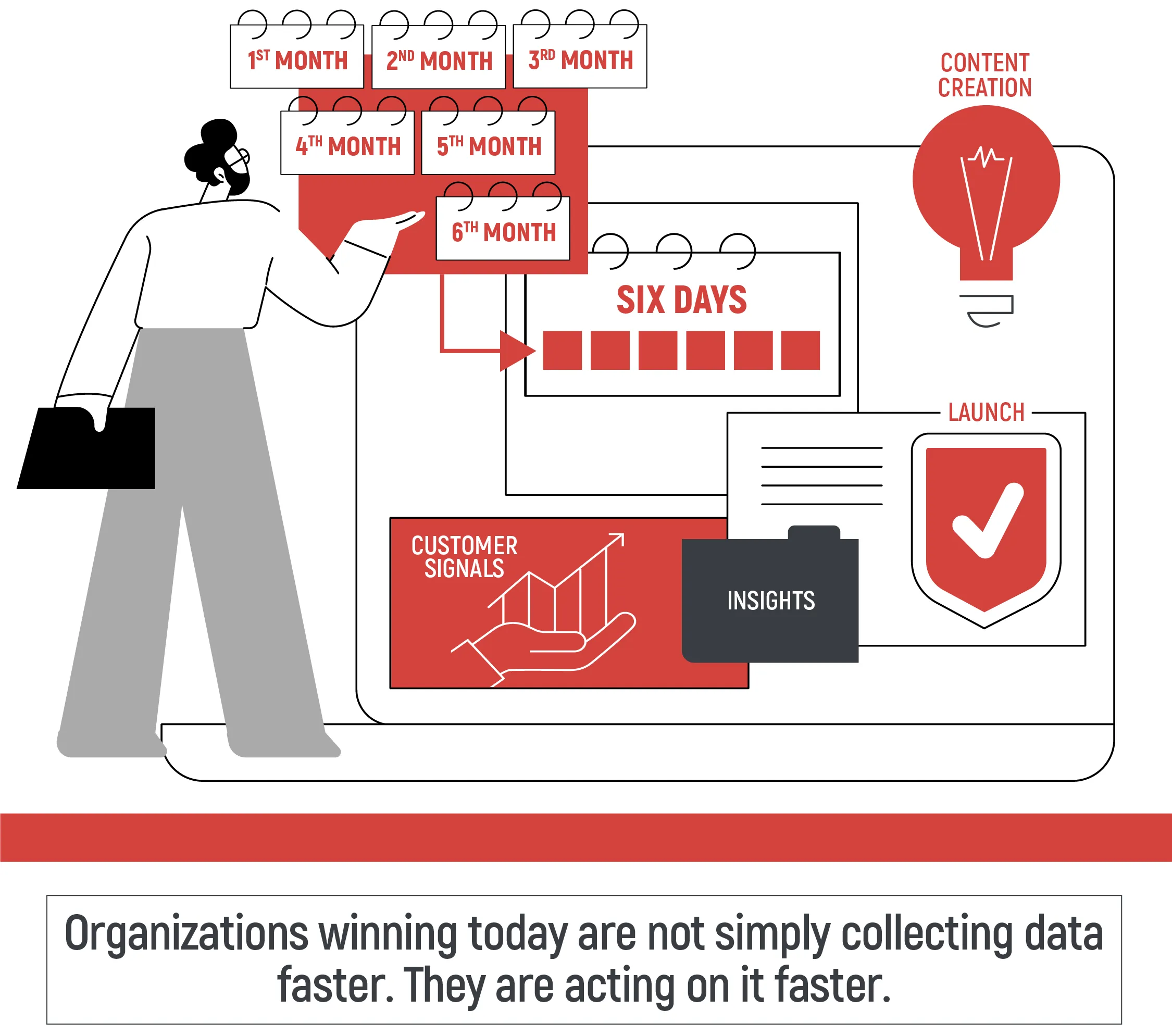
Historically, marketers would identify emerging customer signals, cultural trends, or market shifts and then spend months translating those insights into campaigns.
Today, that timeline is collapsing.
Organizations are increasingly using AI to identify customer sentiment, analyze market feedback, optimize messaging, and launch campaigns in a matter of days rather than months.
Speed is (truly) becoming a competitive advantage.
That arc, from intuition to AI-orchestrated workflows, is echoed across the consulting world. McKinsey describes AI-enabled personalization as the “next frontier” for growth, while Bain argues that modern marketing wins come from data-driven experimentation and content factories that embed AI directly into day-to-day execution.
The organizations winning today are not simply collecting data faster. They are acting on it faster.
Why Human Strategy Matters More Than Ever
Ironically, the rise of AI is making human strategy even more valuable.
During our conversation, I shared a frustration many marketers experience today. Too often, business leaders assume they can simply ask ChatGPT for a brand strategy and call it a day.
Anyone who has built a successful brand knows it doesn’t work that way. And my recommendation for those of you thinking about trying to crunch that brand launch critical timeline with your ChatGPT buddy…don’t do it, but do keep reading.
Brand strategy requires research, segmentation, competitive intelligence, customer understanding, positioning, and a deep appreciation for what makes an organization unique.
AI can help process information.
It cannot replace the strategic thinking required to define what a brand stands for.

Lauren Esposito
Lauren Esposito, MBA , CMO at Asymbl and former VP of Marketing at Salesforce reinforced this point during StrategyCast Episode 575 and shared “….the humans are the ones who are able to understand those contexts, understand human thinking and propose solutions, and then the AI can augment, right. That human capacity to take action and drive outcomes at scale and speed that we wouldn’t see before.”
She followed with another observation that feels especially relevant today after my visit with Boobesh, “I think it’s an interesting balance to keep in mind that your human workforce remains still paramount than ever. Our taste, strategic thinking and psychological understanding is just something that AI is not going to be able to deliver well.”
That balance between technology and humanity may become one of the defining leadership challenges of the next decade.
Building Trust at Scale
At Avocet, trust sits at the center of everything we do.
Whether we’re marketing to consumers, healthcare professionals, manufacturers, or enterprise buyers, trust remains the foundation of every successful customer relationship.
Boobesh offered an important reminder about how trust functions in an AI-powered world.
Customers don’t necessarily care whether content was generated by AI or by a human.
What they care about is whether it resonates.
- Does it understand them?
- Does it solve a problem?
- Does it align with what they value?
That means authenticity is no longer about avoiding technology. It is about ensuring technology serves the customer experience rather than replacing it.
The brands that win will be the ones using AI to become more relevant, more responsive, and more helpful while remaining deeply human in their strategy and purpose.
The Marketers Who Will Thrive
As our conversation came to a close, I asked Boobesh who is most at risk of being left behind.
His answer was immediate, “Anybody who is using AI as a tool and not really including that in their workflow design is at risk.”
That statement perfectly captures the challenge facing marketers today.
AI. Is not. Replacing marketing.
Please repeat this 4x today, tomorrow and forward, because marketers who fail to learn how to work alongside AI may find themselves struggling to keep pace.
The future belongs to marketers who can combine strategy, creativity, customer understanding, and AI-enabled execution into a unified operating model. Why? Because:
- Technology will continue to evolve.
- The human advantage will remain.
Questions to Ask Yourself:
- Are you treating AI as a standalone tool or integrating it directly into your marketing workflows?
- Where could AI accelerate decision-making without compromising quality or trust?
- Is your organization shortening the time between customer insight and campaign execution?
- How are you balancing AI-powered personalization with authentic human connection?
- What parts of your marketing process require human judgment, and what parts could benefit from automation?
The future of marketing will not be defined by who has access to the most AI tools. It will be defined by who can combine human insight with AI-driven execution most effectively.
If you’d like to dive deeper into this topic, listen to Lori Jones’ conversation with Boobesh Ramadurai on StrategyCast, where they explore AI-powered marketing, workflow orchestration, personalization, trust, and what it truly takes to turn AI into measurable business impact.