
Key Takeaways:
- Buyers today are evaluating risk before opportunity.
- Credibility now matters more than creativity alone.
- Specificity and operational proof build trust.
- Modern marketing must uncover truth, not manufacture perception.
- The strongest brands reduce uncertainty through clarity and validation.
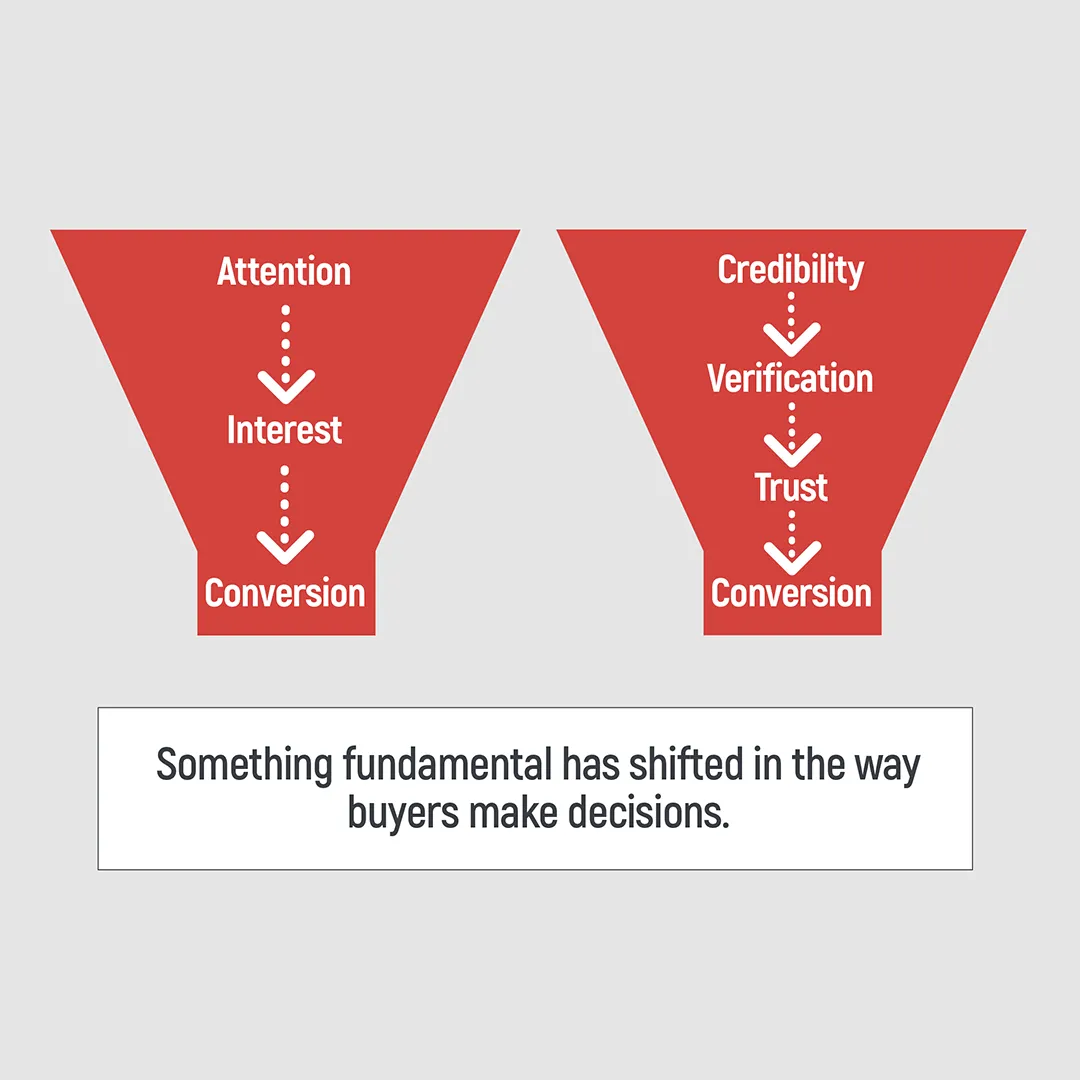
Something fundamental has shifted in the way buyers make decisions.
On a recent StrategyCast solocast, I found myself reflecting on something that has fundamentally changed in modern marketing: buyers no longer make decisions the way they used to. For years, marketers operated under a relatively simple assumption: if you could capture attention, generate interest, and tell a compelling story, conversion would follow. Creativity was often viewed as the primary differentiator. The boldest campaign, the sharpest positioning, or the most memorable brand experience usually won.
Today’s marketplace is evolving into a three-dimensional matrix with so many visual and data driven qualifiers vying for decision-maker attention that it’s operating very differently from anything we’ve witnessed before in the history of marketing and advertising,
It’s frenetic and it’s fascinating.
We are living through an era defined by information overload, institutional skepticism, AI-generated content, and increasingly cautious buyers. Customers are no longer simply evaluating products or services. They are evaluating credibility. And in many cases, they are doing so with a level of scrutiny that businesses have never faced before.
The reality is this: creativity may still earn attention, but credibility is what earns belief.
The Modern Buyer Is a Risk Manager
One of the biggest mistakes organizations make today is assuming buyers are still operating from a place of curiosity and exploration. In reality, most buyers are approaching decisions from a place of caution, that has been validated by extensive research done well in advance.
The 2026 Edelman Trust Barometer continues to show declining trust across institutions, industries, and information sources. People are filtering more aggressively. They are questioning more deeply. They are looking for reasons not to believe before they look for reasons to engage.
That shift fundamentally changes the role of marketing.
Today’s buyers are not simply asking: “Is this interesting?”
They are asking: “Can I trust this?”
MJ Patent, Chief Marketing Officer at Logically,shared her recent experiences that, not surprisingly, echoed my observations about buyers evaluating risk rather than operating on impulse. She noted, “…I’ve dealt with highly informed, skeptical buyers. They’re not your typical impulse buyers. They are all about risk management”.

MJ Patent
She further touched on the exact environmental shift we are witnessing regarding AI noise and general skepticism, adding that when “…you layer on what’s going on with AI, right? We have deep fake technologies… You don’t know what’s real, what’s not real… And so everyone is starting to get into a very defensive posture”. StrategyCast Episode #587
Buyers are no longer evaluating possibility first. They are evaluating risk.
Why Creativity Alone No Longer Converts
This does not mean creativity has lost its value. Far from it.
But the role of creativity has evolved.
In many industries, especially technical, industrial, and B2B environments, buyers are not looking for inspiration alone. They are looking for certainty. They want proof that a company can actually deliver what it claims.
And this is where many brands unintentionally create skepticism.
When marketing becomes more impressive than the product itself, trust begins to erode.
We see this constantly in the marketplace. Companies lead with broad claims about innovation, reliability, or customer experience, but fail to provide the operational truth that validates those statements. The sniff test reveals the true underbelly of the product or service that no hype campaign or headline can mask.

Steve Shaw
Steve Shaw, product marketing executive, thought leaders and expert in complex mobile app and telecom systems, recently articulated this challenge perfectly when he observed, “…I was on a website the other day, and the H1 header right there on the front was something like, we have the most reliable product. And then H2 header was all about trust. Trust. Trust. Where are my proof points for reliability? Like, if you’re gonna lead with reliability, I expect everything below it to be reliable…”StrategyCast Episode #491
That insight gets to the heart of modern credibility.
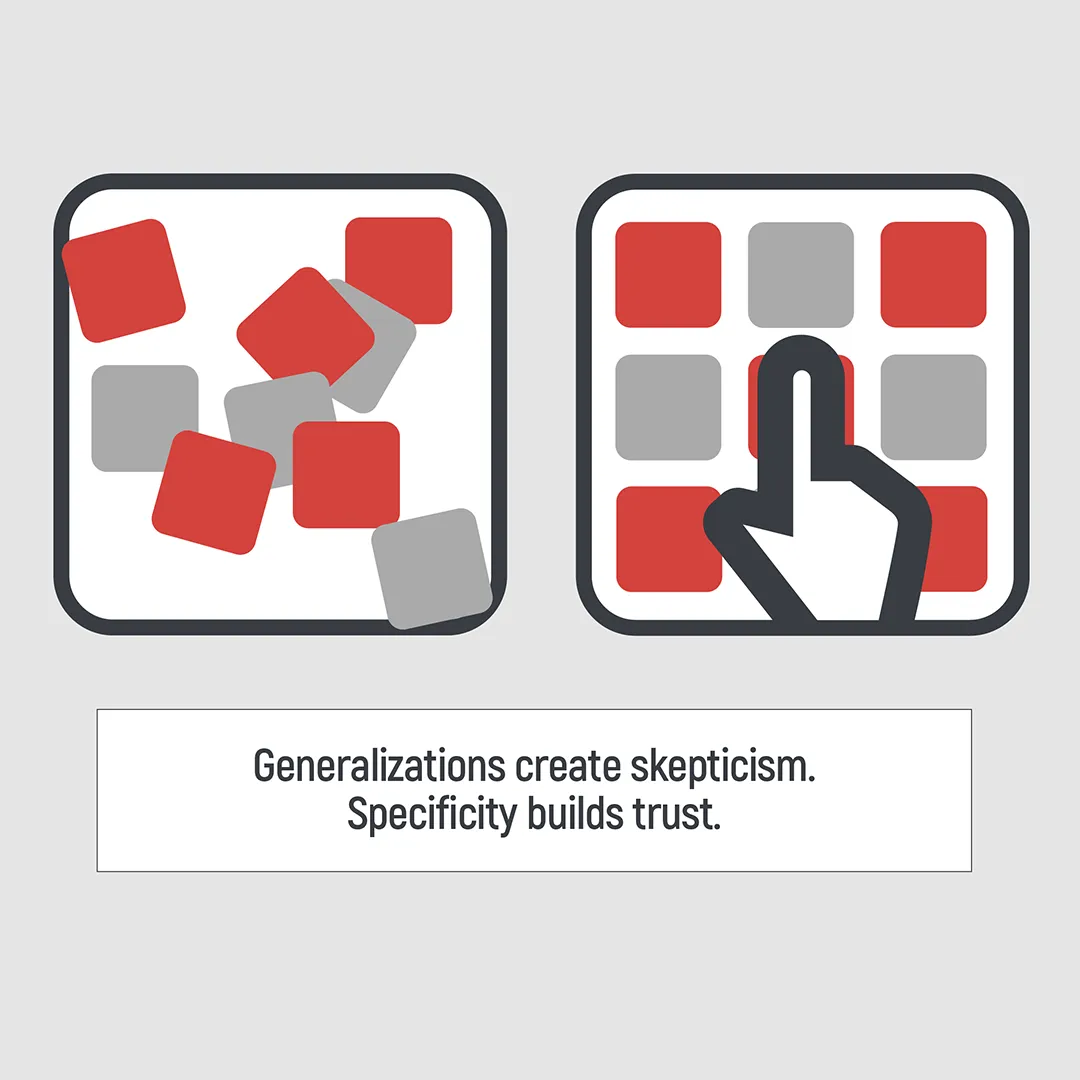
Generalizations create skepticism. Specificity builds trust.
Let the Operation Become the Marketing
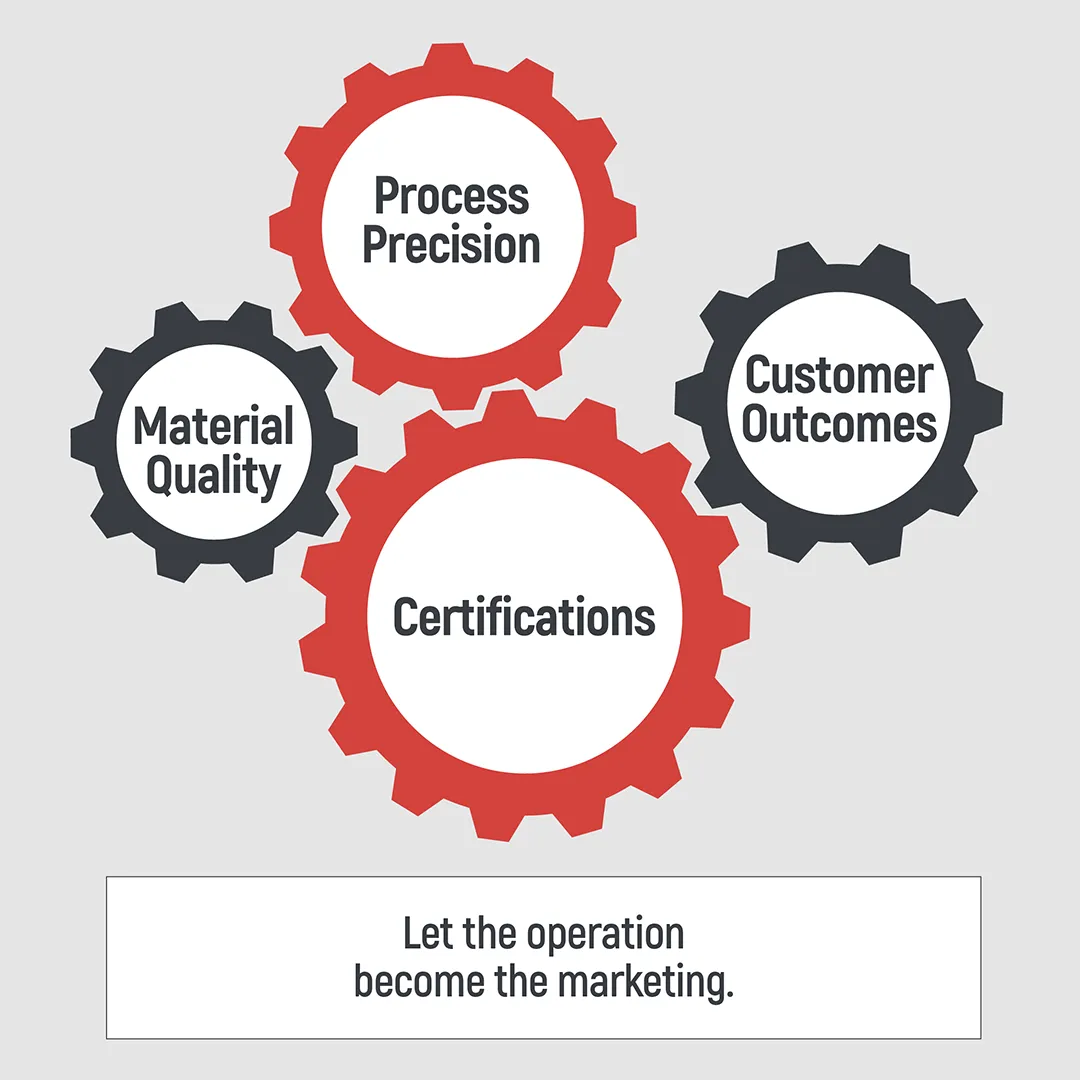
One of the most powerful shifts organizations can make is recognizing that the strongest marketing messages often already exist inside the business itself.
The real story is frequently found in the operation.
It lives in the process.
The people.
The manufacturing precision.
The customer outcomes.
The consistency.
The accountability.
The challenge is not inventing a more compelling narrative. The challenge is uncovering and translating operational truth into market credibility.
This became especially clear in our work with Charter Casting, a world-class, North American iron manufacturing client. Their competitive advantage was never flashy marketing. It was the precision of their operation, the consistency of their product quality, and the reliability they had built over decades.
Those strengths already existed. They simply were not visible enough to the market.
Instead of asking how to make the company sound more exciting, we focused on making the company more believable. We shifted from broad positioning language to highly specific proof. We highlighted material performance, process rigor, tolerances, customer applications, and operational consistency.
The result was not louder marketing. It was clearer marketing.
And clarity creates confidence.
Clarity Is the New Competitive Advantage
One of the most important lessons modern marketers must embrace is this:
Creativity should clarify, not exaggerate.
The strongest marketing today does not distract buyers from complexity. It helps them navigate complexity with confidence.
That means simplifying technical information. Making proof accessible. Structuring information clearly. Reducing uncertainty at every stage of the buyer journey.
In many ways, clarity has become the new currency of trust.
Organizations that communicate with transparency and specificity immediately separate themselves from competitors relying on vague positioning and over-polished messaging.
And in skeptical markets, the safest choice often wins.
Credibility Is a Strategy
Too often, organizations treat credibility as a supporting tactic rather than a strategic foundation. But in today’s marketplace, credibility is not something you layer into a campaign at the end.
It is the strategy.
Because when trust is present:
- Sales cycles shorten.
- Skepticism decreases.
- Customer loyalty strengthens.
- Advocacy increases.
- Decision-making accelerates.
The companies that will lead in the years ahead will not simply be the loudest brands or the most creative brands. They will be the organizations that consistently prove what they promise.
They will be the companies that understand a simple but powerful truth:
Attention may open the door. But credibility is what gets buyers to walk through it.
Questions to Ask Yourself:
- Are your marketing efforts creating attention or creating belief?
- Where does skepticism show up most in your buyer journey?
- Are your claims supported by visible operational proof?
- What truths inside your organization deserve greater visibility?
- Is your marketing helping buyers feel inspired or helping them feel confident?
Trust is no longer assumed in business. It must be earned intentionally through consistency, proof, and operational transparency. In a marketplace shaped by skepticism and information overload, the organizations that win will not simply be the most visible. They will be the most believable.
If you’d like to explore this topic further, I invite you to listen to my latest StrategyCast solo episode, where I dive deeper into the evolving relationship between credibility, buyer behavior, and modern marketing strategy.