
“There has never been so much change and so much pressure in corporate America as there is today.” — Debbie Qaqish
Key Takeaways:
- Constant pressure changes how leaders think, decide, and perform.
- Strategic clarity requires intentional pauses, not relentless execution.
- Psychological safety and human connection are critical leadership responsibilities.
- Thriving, not simply surviving, has become a modern performance strategy.
- Leaders who manage pressure effectively make better decisions and drive stronger business outcomes.
Somewhere along the way, many leaders were taught that constant pressure is simply the price of success. We’ve come to equate working harder, moving faster, pushing through exhaustion, and staying perpetually available with commitment, ambition, and high performance. The problem? What feels like commitment and drive can quietly become the very thing undermining our judgment, creativity, and ability to lead effectively.
During my recent, and fascinating conversation with Dr. Debbie Qaqish, Founder & CEO of The Growth Factor on StrategyCast, we explored a reality many leaders are experiencing but few are discussing openly: the hidden cost of operating under relentless pressure.

Dr. Debbie Qaqish
Like many of you, I spend my days helping organizations navigate change. Marketing leaders today are expected to drive growth, embrace new technologies, adapt to shifting customer expectations, and somehow maintain team alignment while the pace of business continues to accelerate.
It’s exhausting.
What Debbie articulated so powerfully is that the pressure many leaders feel today isn’t simply a personal challenge. It’s a neurological one.
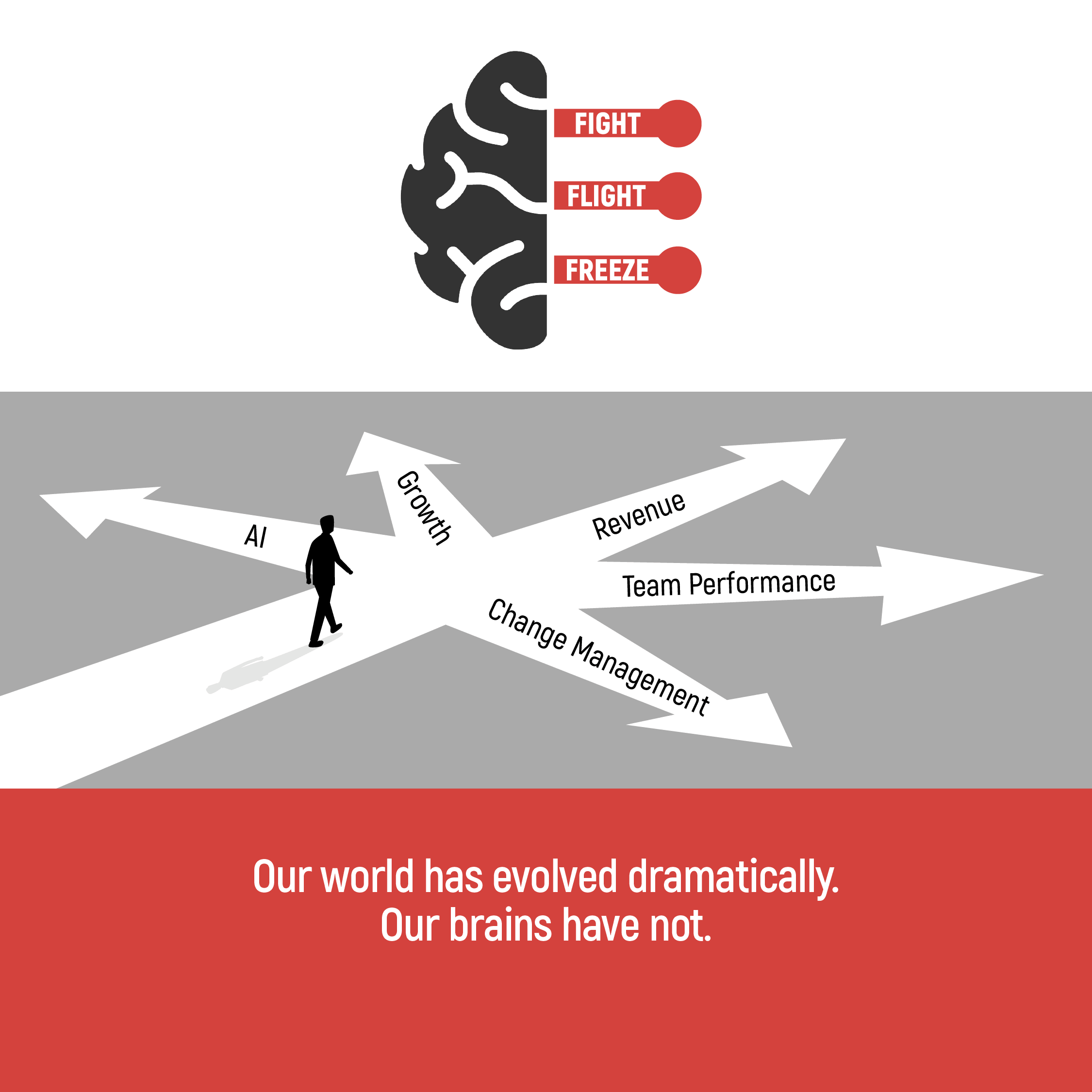
Our world has evolved dramatically. Our brains have not.
When Pressure Becomes the Default Operating System
Debbie described how sustained pressure narrows our thinking. Instead of accessing strategic, innovative problem-solving, leaders often find themselves trapped in what she calls “lizard brain” mode: fight, flight, or freeze.
The result?
Short-term decisions. Safer choices. Reactive leadership.
And unfortunately, those reactions ripple throughout the organization.
I’ve witnessed this firsthand. During a recent one-on-one conversation with a younger team member, she shared that she sometimes felt like she was “walking on eggshells” when coming into the office. At first, I was surprised. We work hard to foster a positive environment.
But after digging deeper, I realized she wasn’t describing toxicity. She was describing pressure.
That conversation was a powerful reminder that leadership isn’t just about strategy. It’s about awareness.
Why Strategic Thinking Requires Space
One of the most impactful moments of our discussion centered around something deceptively simple: creating space.
Debbie emphasized that leaders cannot continue operating in a constant whirlwind and expect strategic thinking to emerge naturally.
That insight immediately reminded me of a concept discussed with me last year by Carla Johnson, Innovation Architect and Founder of RE:Think Labs. Carla advocates for intentionally stepping away from work to clear mental clutter and create room for innovation. Whether it’s a walk outside, observing your surroundings more intentionally, or simply disconnecting for a few moments, the act of creating space allows your brain to reset.

Carla Johnson
As Debbie explained, strategic thinking requires access to the very cognitive functions that pressure often shuts down.
Celia Fleischaker, CMO and expert in transformational technology verticals, reinforced this same principle during StrategyCast Episode 526 when she shared. “Stepping back and even a 10 minute pause, like, stepping away from the computer, the team’s meetings, and clearing my head… I come back, and I’m always so refreshed… it tends to make me more creative. I can think about things differently.”

Celia Fleischaker
That’s not a luxury.
It’s a leadership discipline.
The real danger isn’t feeling stressed.
The real danger is becoming so accustomed to pressure that we mistake survival mode for high performance.
The New Performance Strategy: Helping People Thrive
Perhaps the most provocative idea Debbie shared was this: thriving has become a business strategy.
For years, organizations focused on process improvements, organizational redesigns, and technology implementations to drive performance. While those initiatives remain important, they’re no longer enough.
Today’s challenge is helping people perform at their best amid unprecedented complexity.
What’s particularly concerning is that many leaders don’t recognize the impact because constant pressure has become normalized. We wear busyness as a badge of honor, celebrate packed calendars, and reward constant responsiveness, all while mistaking exhaustion for effectiveness and activity for performance.Yet mounting research suggests the cognitive cost may be far greater than we realize.
This isn’t just a “soft skills” concern. Recent research in Harvard Business Review finds that certain patterns of AI use are literally causing “AI brain fry”, cognitive overload that drives decision fatigue, more mistakes, and higher burnout, prompting BCG’s authors to argue that leaders must redesign workflows so AI reduces threat responses instead of amplifying them in When Using AI Leads to ‘Brain Fry’.
The organizations that win will not simply adopt better tools.
They will build healthier leaders.

Leadership Starts With Intentionality
One of the themes Debbie and I dove deeper into was psychological safety.
When people feel they cannot ask questions, raise concerns, challenge assumptions, or admit uncertainty, performance suffers. Innovation slows. Collaboration weakens. Trust erodes.
Ironically, in an age increasingly dominated by technology, authentic human connection may be more valuable than ever.
As leaders, we cannot remove every source of pressure. But we can create environments where people feel supported, valued, and safe enough to do their best work.
That starts with how we show up.
“If you can show up to work every day with clarity, with purpose, that is intentional and not reactive, performance will improve. Period.” — Debbie Qaqish
Questions to Ask Yourself:
- Are you operating strategically or simply reacting to what’s immediately in front of you?
- What habits help you reset when pressure begins to impact your decision-making?
- Does your team feel psychologically safe enough to speak openly about stress and workload?
- How are you helping your people thrive, not just perform?
- What would change if you intentionally created more space for reflection and strategic thinking?
If you’d like to learn more, listen to Lori Jones’ conversation with Debbie Qaqish on StrategyCast, where they explore leadership performance, decision-making, thriving under pressure, and why strategic clarity may be one of the most important competitive advantages of the AI era.