“Trust is not soft. Trust is a scalable dependency.”
Jeff Chancellor
Every once in a while, a conversation about AI turns out not to be about AI at all.
That’s exactly what happened when I sat down with Jeff Chancellor, CMO at Oversight.

Jeff Chancellor
I was genuinely excited to have Jeff join me because his career has given him a front-row seat to some of the biggest shifts in technology and business, from digital and mobile to cloud, SaaS, and now AI. But what I especially appreciated about our conversation was where he took it. We didn’t spend our time chasing the newest tools or predicting which technology will change everything next.
Instead, we talked about leadership.
We talked about trust, accountability, operating discipline, and the quality of the decisions an organization makes. And Jeff made a point that I believe every CEO, CMO, and business leader should be thinking about right now:
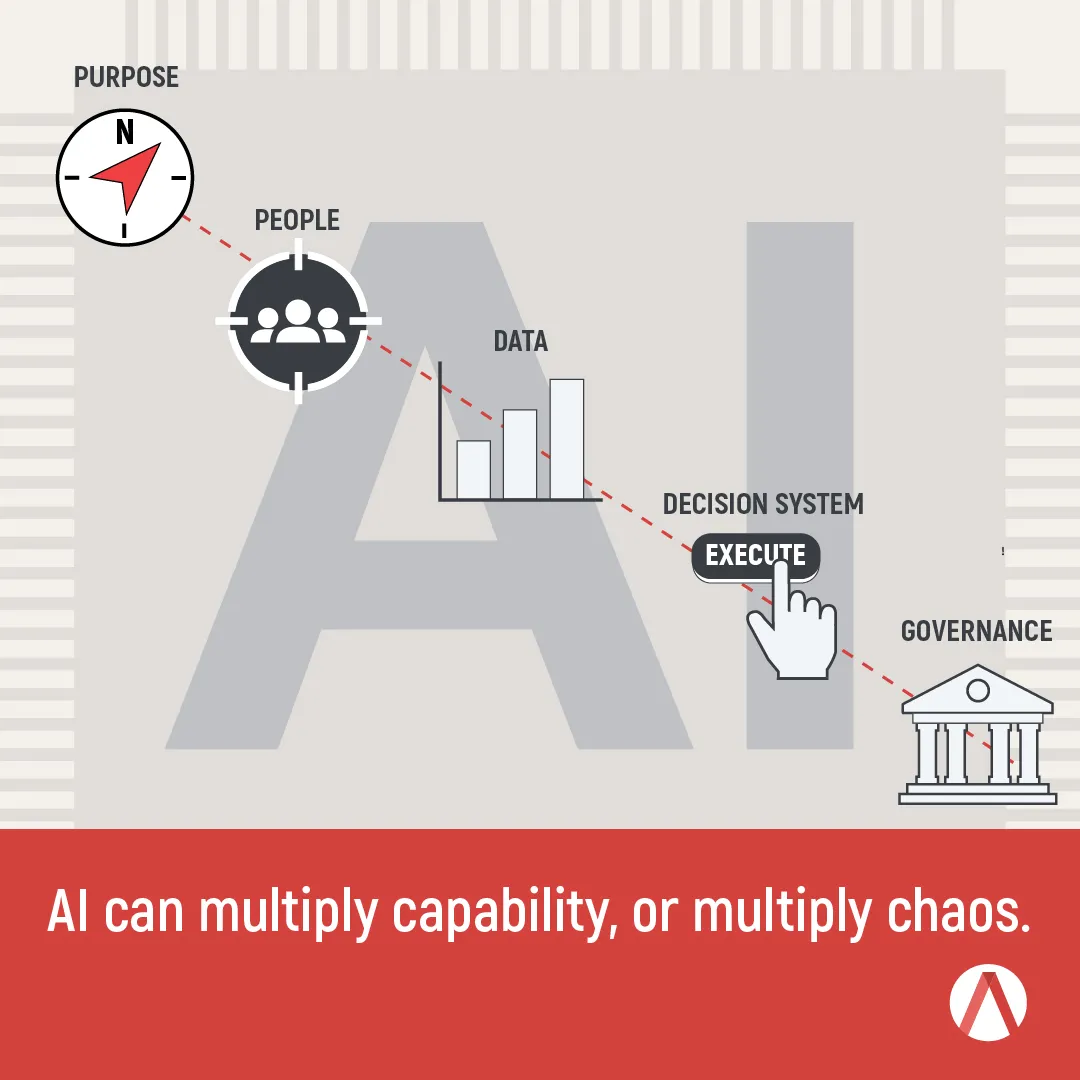
AI can make an organization faster. But if the foundation underneath it is weak, it may simply make the organization faster at creating chaos.
That changes the question leaders need to ask.
It’s no longer simply, “What can AI do for us?”
It’s, “Are we building an organization that is actually ready for what AI can do?”
We Are Moving Beyond Experimentation
For the last several years, most organizations have been asking capability questions.
Can AI write this? Summarize that? Automate this workflow? Analyze this data?
Those experiments were necessary. But Jeff believes we have reached an important inflection point. The question is becoming less about what AI can do and more about whether organizations are prepared to depend on it.
When AI begins influencing pricing, customer engagement, forecasting, investment decisions, operational execution, or financial risk, it stops behaving like another application.
It becomes infrastructure.
And infrastructure requires trust.
Trust Is Becoming an Economic Driver
Trust is often treated as an ethical or compliance conversation. Jeff reframes it as something more fundamental.
Employees must trust AI recommendations before incorporating them into their work. Customers must trust AI-powered experiences before accepting them. Executives must trust AI-generated insights before making consequential decisions.
No trust means slower adoption. Slower adoption means slower value creation.
This is why transparency matters. People do not necessarily expect AI to be perfect. They need to understand how a recommendation was reached, what informed it, what assumptions were made, and who remains accountable.
Deloitte’s 2026 Global Human Capital Trends research underscores the gap. Sixty percent of executives regularly use AI to support decision-making, but only 5% consider themselves leaders in managing AI-enabled decision-making effectively.
That tells me the competitive advantage will not come from automation alone. It will come from disciplined systems of trust, transparency, accountability, and decision quality.
AI Cannot Repair a Weak Operating Foundation
Jeff offered one of the most useful frameworks from our conversation:
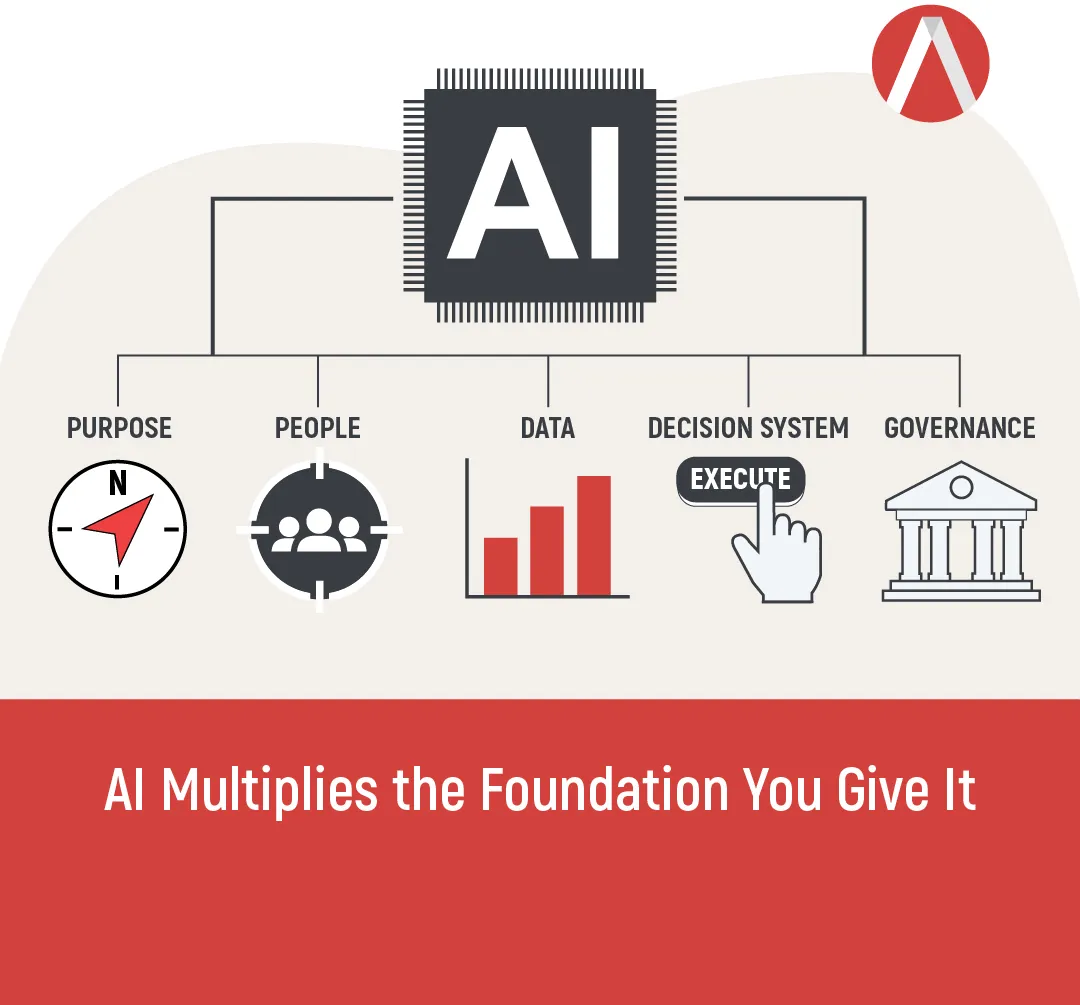
“I think about that foundation in five layers: purpose, people, data, decision systems, and governance.”
Technology supports those five layers. It does not replace them.
This is where another StrategyCast conversation comes to mind. Strategy and execution consultant Andrew Dod warned in StrategyCast Episode 504:
“The problem is companies lack either the discipline or the framework to accomplish and execute their strategies. They know how to write them… but they don’t have the capability to think through what those decisions might make.”

Andrew Dod
That connection is critical.
A strong AI strategy without organizational buy-in, alignment, clear ownership, and operating discipline is still a weak strategy. As Jeff put it, organizations do not scale technology. They scale operating discipline.
The CMO Is Becoming an Architect of Decision Quality
This evolution has enormous implications for marketing leaders.
The CMO still owns customers, brand, demand, and value creation. But marketing now sits at the intersection of customer intelligence, enterprise data, AI, revenue operations, digital experience, and commercial strategy.
Jeff describes the modern CMO as an architect of decision quality.
I love that framing.
Our value cannot simply be measured by how many campaigns we launch. Increasingly, it will be measured by how effectively the organization learns from signals, adapts, aligns its people, and turns insight into better decisions.
Jeff has seen this firsthand through Oversight’s one-to-one ABX efforts. Marketing’s confidence in the system was not enough. SDRs and sellers also had to trust it. Buy-in grew when those teams experienced better conversations with prospects who were already further along in their buying journey.
That is an important reminder for all of us. Transformation does not happen because leadership announces it or because marketing adopts a new platform. It happens when people throughout the organization experience the value themselves and begin trusting the system.
Move Fast Until Responsibility Requires You to Slow Down
There was another distinction from Jeff that I think leaders should pay close attention to.
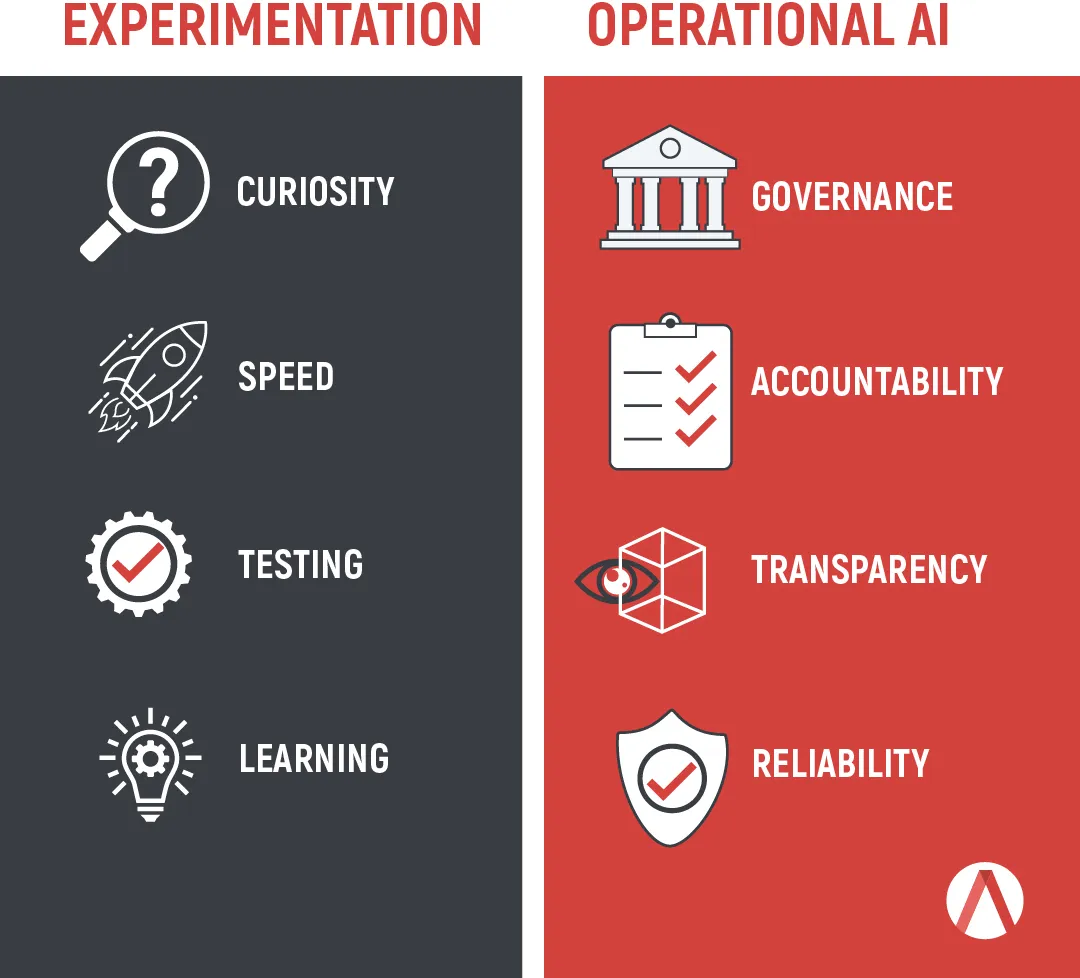
Organizations need to operate at two speeds.
During experimentation, move quickly. Encourage curiosity. Test ideas. Learn aggressively.
But when AI begins influencing customer experiences, financial decisions, operational workflows, or enterprise risk, the rules change.
As Jeff put it: “Operational AI deserves operational governance.”
That is not an argument for slowing innovation. It is an argument for knowing when experimentation has become infrastructure.
We have watched this pattern unfold with every major technology transformation. Organizations initially optimize for adoption. Eventually, they must optimize for reliability.
AI will be no different.
Better Technology Is Not the Finish Line
AI will keep getting faster, smarter, and more embedded in our businesses.
The leadership question is whether our organizations will mature with it.
The winners will not simply have better AI. They will have clearer purpose, stronger operating systems, greater accountability, healthier alignment, and leaders who understand when to move quickly and when discipline must take over.
This is where I believe marketing leaders have an extraordinary opportunity. We are no longer simply helping organizations communicate what they believe. Increasingly, we are helping organizations understand customers, interpret signals, connect data, align teams, and make better decisions.
That is a much bigger responsibility.
And perhaps a much bigger opportunity.
Jeff left me with a line that deserves to sit on every leadership team’s agenda:
“Organizations compete on the quality of their decisions.”
Technology changes. That principle does not.
Questions to Ask Yourself
- Is AI improving the quality of your decisions, or simply increasing their speed?
- Which of your five operating layers is strongest today, and which is creating risk?
- Do your people understand why AI makes a recommendation and who remains accountable?
- Have you built organizational trust and alignment before trying to scale AI?
- Is your marketing organization becoming an architect of better enterprise decisions?
If you want to explore these ideas further, I encourage you to listen to my conversation with Jeff Chancellor on StrategyCast Episode 605 where we discuss AI adoption, trust, transparency, operating discipline, the changing role of the CMO, and why the organizations that thrive in the AI era will compete on the quality of their decisions.