
“The problems are going to be fixed early. They’re going to be fixed in the foundation, and then you’re going to be able to go faster for longer.” – Tara DeZao
I think we have reached an important inflection point with AI.
We know it can make us faster and we know it can make us more efficient.
But can it make our brands more trusted?
Tara DeZeo, Sr. Director of Product Marketing at Pegasystems is passionate about helping organizations create more empathetic customer experiences powered by AI, and from the beginning of our conversation, I was struck by how closely her thinking aligns with something I believe deeply: trust is not something we add after the strategy is built. It has to be part of the foundation.

Tara DeZeo
In this week’s StrategyCast conversation, we talked about governance, AI agents, authenticity, customer experience, human judgment, organizational silos, and what happens when companies become so enamored with speed that they forget to ask what they may be sacrificing to achieve it.
And perhaps the most important takeaway is this:
The AI race may not ultimately be won by the company that moves fastest.
It may be won by the company customers trust enough to follow.
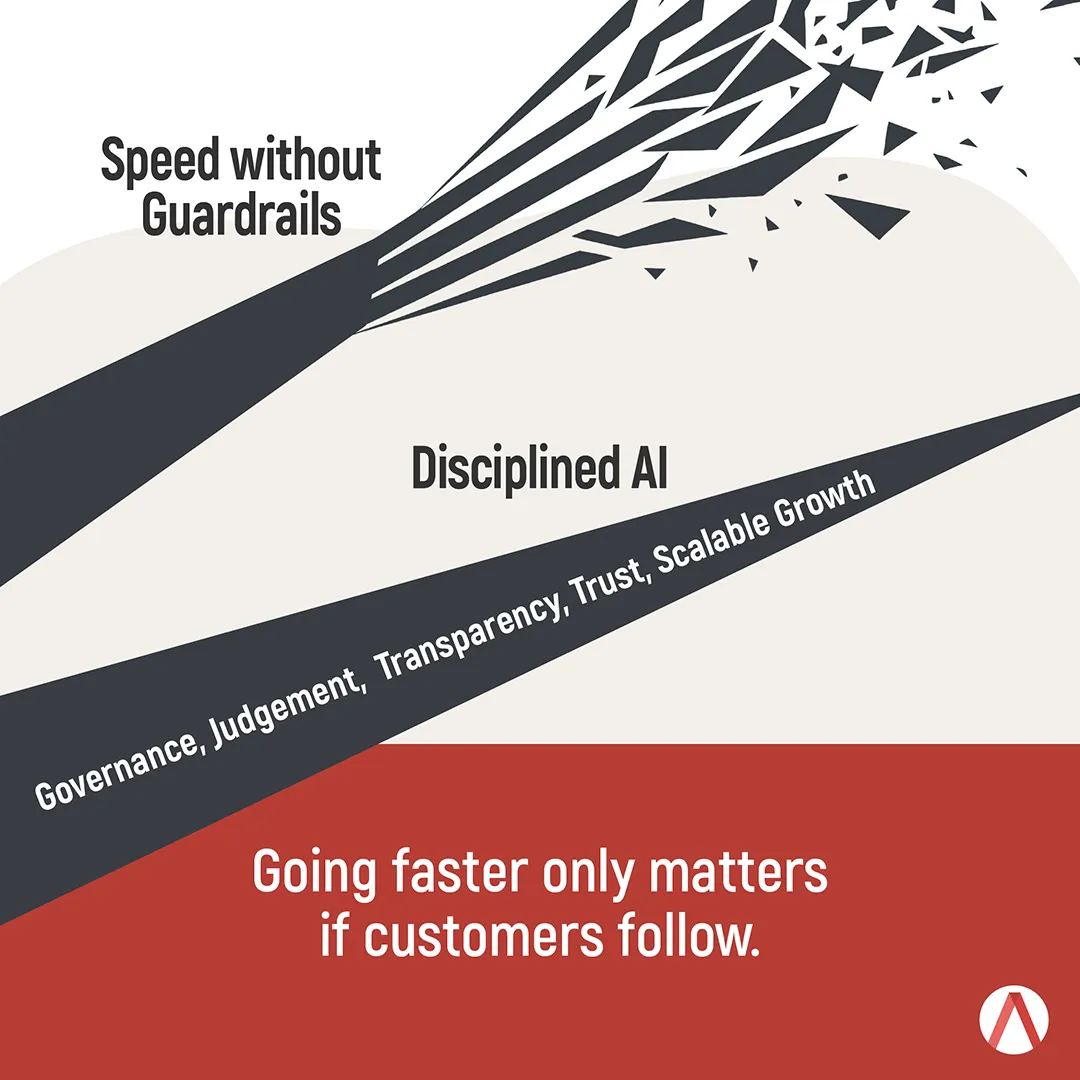
Governance Is Not the Brake. It Is the Guardrail.
Governance has a branding problem.
The word can sound bureaucratic. Slow. Restrictive.
But Tara sees it differently.
The organizations she sees succeeding with AI are using governance standards as guardrails for their strategies. Instead of building first and fixing problems later, they establish the boundaries from the beginning.
That distinction matters enormously.
Boston Consulting Group recently made a similar argument, recommending that organizations create a centralized, cross-functional AI hub with explicit authority across strategy, data, risk, legal, adoption, and value measurement. The objective is not to create another layer of bureaucracy. It is to keep fragmented AI initiatives from becoming disconnected or rogue while embedding responsible oversight throughout design, deployment, monitoring, and scaling.
BCG argues that this kind of centralization can actually create speed by bringing the right expertise together and making governance operational from the beginning. Read BCG’s analysis of why organizations need an AI hub.
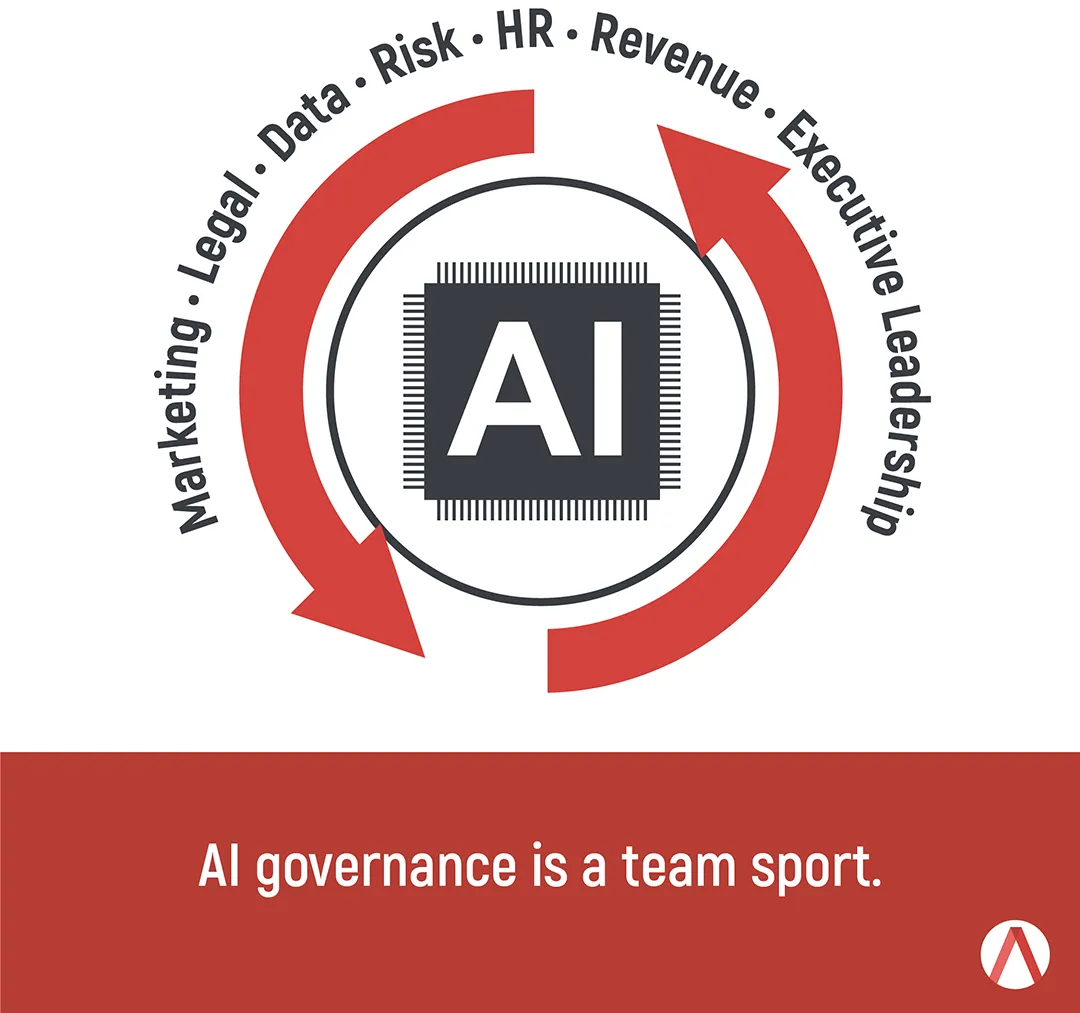
That reinforces something Tara emphasized throughout our conversation: AI governance is not simply IT’s responsibility.
Marketing. Legal. Technology. Risk. Revenue. Data. Leadership.
Everyone has a role.
Tara described organizations establishing governance boards with leaders from multiple functional areas who understand how AI is being deployed and what policies surround it.
That creates accountability.
And accountability creates confidence.
Your AI Should Be a Collaborator, Not an Unsupervised Employee
One of the most dangerous assumptions leaders can make is that greater AI capability automatically means less need for human involvement.
Tara argues almost exactly the opposite.
“It is a collaboration tool. It is not a replacement tool.”
That is an important distinction for marketers.
AI can recognize patterns. It can accelerate production. It can generate creative variants, analyze enormous datasets, identify signals, and help teams respond faster.
But should it independently make every customer decision?
Should it publish every creative asset?
Should it communicate externally without clear permissions?
Absolutely not.
Tara shared the example of an advertisement from a reputable brand featuring a human with three arms.
Think about how many checkpoints that creative had to pass before reaching the market.
AI may have generated the mistake.
Humans allowed it through.
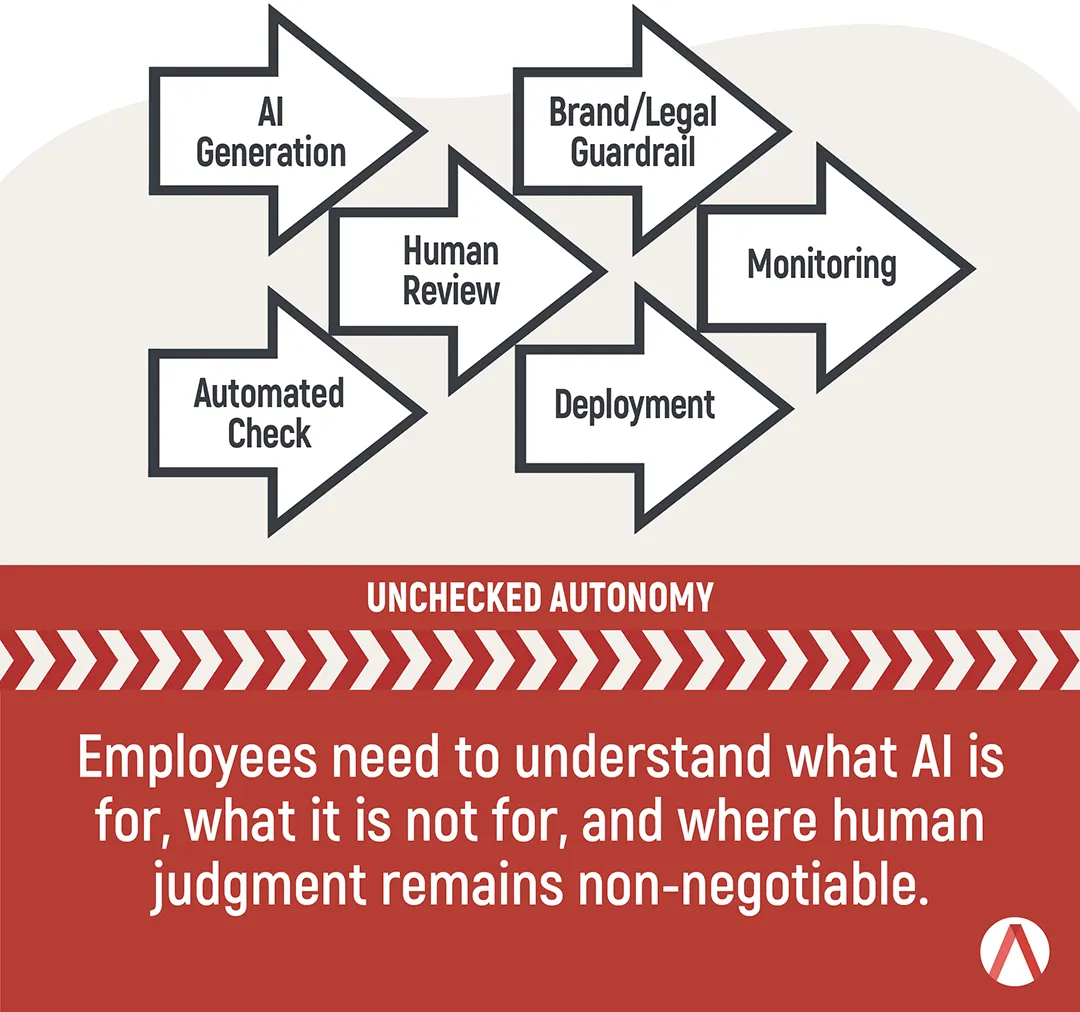
That is why the phrase “human in the loop” cannot become another piece of AI jargon. It has to represent an actual operating discipline.
Defined workflows matter. Permissions matter. Testing matters. Model monitoring matters.
Judgment matters.
Trust Has to Start Inside the Organization
This conversation brought me back to something foundational at Avocet.
We build belief systems.
Whether we are helping launch a new product, change a market perception, or strengthen a company’s reputation, belief cannot simply be manufactured externally.
The organization has to walk the walk internally first.
The same is true with AI.
Employees need to understand what AI is for, what it is not for, and where human judgment remains non-negotiable.
Tara described weekly workshops within her organization that help employees learn different AI tools while understanding how those tools fit within company policy.
That does more than improve AI competency.
It builds culture.
In an AI World, Authenticity Becomes More Valuable
Tara and I had some fun talking about the signals that immediately tell marketers something was probably generated by AI.
And yes, we talked about em dashes.
But there is a much bigger issue underneath that conversation.
As AI-generated content becomes easier to produce, sameness becomes easier to produce too.
The same colors. The same language. The same images. The same thought leadership.
Consumers notice.
Speed Will Stop Being the Differentiator
Right now, everyone is fascinated by how quickly AI allows organizations to move.
But Tara made an observation that deserves more attention.
Eventually, speed itself will stop being a differentiator.
When everyone can produce faster, analyze faster, personalize faster, and deploy faster, the advantage shifts somewhere else.
To judgment.
To discipline.
To data quality.
To creativity.
And, most importantly, to trust.
That is the opportunity I see for marketing leaders heading into 2027.
Do not ask only, “How much faster can AI make us?”
Ask, “What kind of organization do we need to become so that we can use that speed responsibly?”
Because Tara’s analogy about trust may be the one that stays with me longest:
“Trust is a staircase. It takes a long time to climb up to the top, but if you fall off, it’s right to the bottom.”
AI can help us climb faster.
People determine whether we stay there.
Questions to Ask Yourself
- Is AI governance built into your strategy, or added after deployment?
- Who has the authority to stop an AI initiative when the customer or brand risk becomes too high?
- Where are AI agents acting autonomously today, and where should a human remain in the loop?
- Are you using AI to amplify authentic ideas or simply to create more content?
- If speed becomes universal, what will make customers choose and trust your brand?
If you want to explore these ideas further, I encourage you to listen to my conversation with Tara DeZao on StrategyCast Episode 608, where we discuss AI governance, customer trust, authenticity, human and AI collaboration, agentic technology, organizational culture, and why disciplined AI deployment may become one of the defining leadership capabilities of the next several years.