
There’s a word marketers use constantly: trust.
We want customers to trust our brands. We conduct trust studies. We talk about trusted relationships. We build campaigns designed to increase credibility.
But lately I’ve been asking a different question: What happens after you earn trust?
Because trust, as valuable as it is, isn’t necessarily the destination. When an organization earns trust consistently, something bigger can happen. People begin to form a belief about who you are, what you stand for, and what they can expect from you.
That belief can influence whether they buy, stay, recommend you, forgive a mistake, or follow you into something new.
That’s where trust becomes a growth strategy.
Awareness Is the Entry Point, Not the Finish Line
Marketing has traditionally spent enormous energy generating awareness. And, of course, people have to know you before they can choose you.
But AI has fundamentally changed the information environment. Your customers can research companies, compare alternatives, analyze reviews, investigate leadership, and assemble enormous amounts of information before ever talking to your sales team.
At the same time, AI has made information dramatically easier for companies to create.
That means more information isn’t necessarily more persuasive.
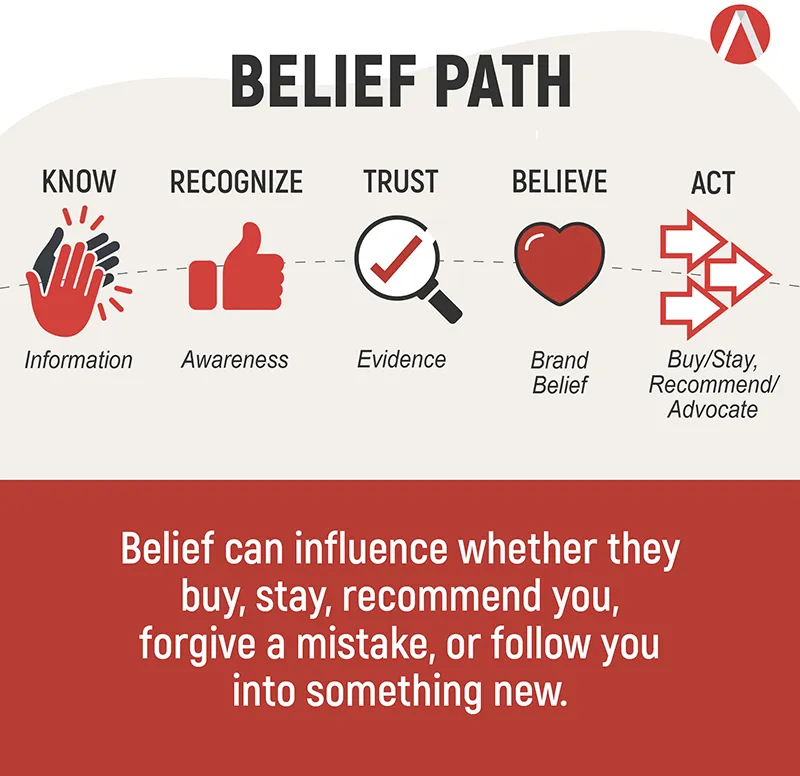
I think about the progression this way, and that is information creates awareness, trust creates belief, and belief inspires action.
The question for marketers, then, isn’t simply, “Do people know us?” It’s, “What happens after they know us?”
A Person Can Ignite Trust. The Organization Must Prove It.
People understand people. That’s why a founder, CEO, or subject matter expert can be such a powerful source of credibility.
We can hear their conviction. We understand their motivations. We watch how they respond to difficult situations and whether their actions remain consistent with their words.
But there is a risk.
What happens when customers trust the founder more than the company? What happens when that leader steps away, or when a growing organization means customers interact with hundreds of employees instead of one recognizable personality?
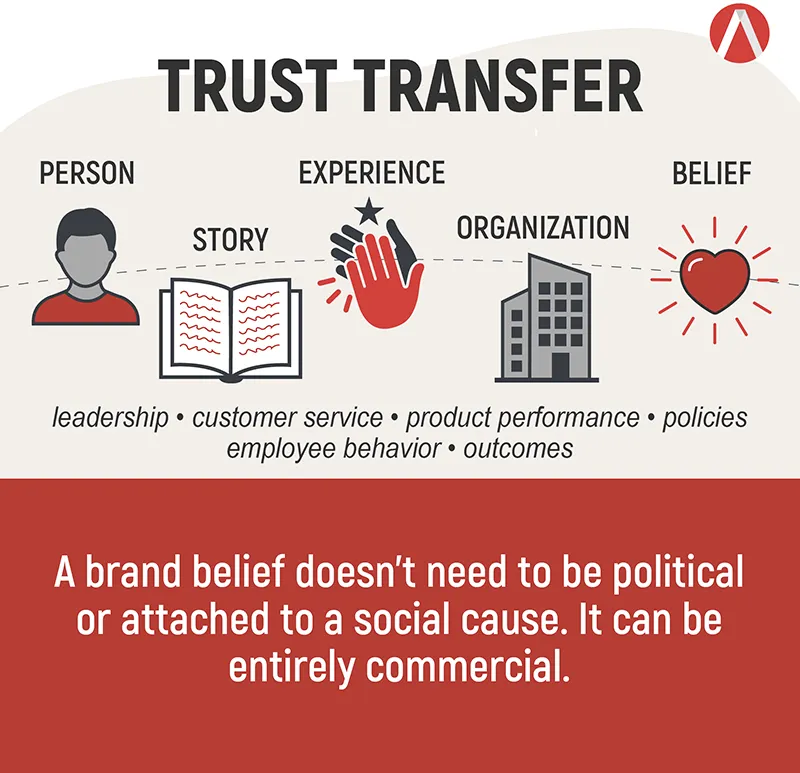
This is where what we call the trust transfer becomes important.
Trust can begin with a person, move into the company’s story, and then be tested through the customer’s actual experience. When that experience repeatedly confirms the story, trust begins transferring from the individual to the organization.
As Alisha Rappaport of Fitch Group explained during our conversation on StrategyCast Episode 583, credibility sometimes requires slowing down enough to ensure what you’re promising matches what you can deliver:
“…you don’t want to overpromise something that you can’t deliver on. I think it’s better for you to be able to answer in a realistic manner about what you believe is happening… In a way that we feel like we’re going to have more success instead of rushing in and then potentially having to put Band-Aids on things.”

Alisha Rappaport
That’s an important distinction. Trust isn’t built by making the biggest promise. It’s built when the promise and the experience consistently match.
Your Brand Belief Has to Show Up Somewhere
Any company can publish a list of values. The better question might be: Where can customers see those values affecting an actual decision?
Did your belief influence the product you built? A customer policy? An investment? Something you refused to compromise? Did it ever cause you to choose the harder path?
A brand belief doesn’t need to be political or attached to a social cause. It can be entirely commercial. You might believe technology should reduce complexity. You might believe customers deserve greater transparency. You might believe innovation should never require customers to surrender privacy.
But the belief has to change something.
Otherwise, it’s positioning.
AI Is Raising the Bar for Believability
This becomes even more important as AI increasingly mediates how customers discover and evaluate brands.
Forrester describes AI agents as a new audience for marketers because these systems retrieve and validate information rather than simply consuming traditional brand narratives. Its guidance emphasizes clear context and “verifiable, consistently expressed facts.”
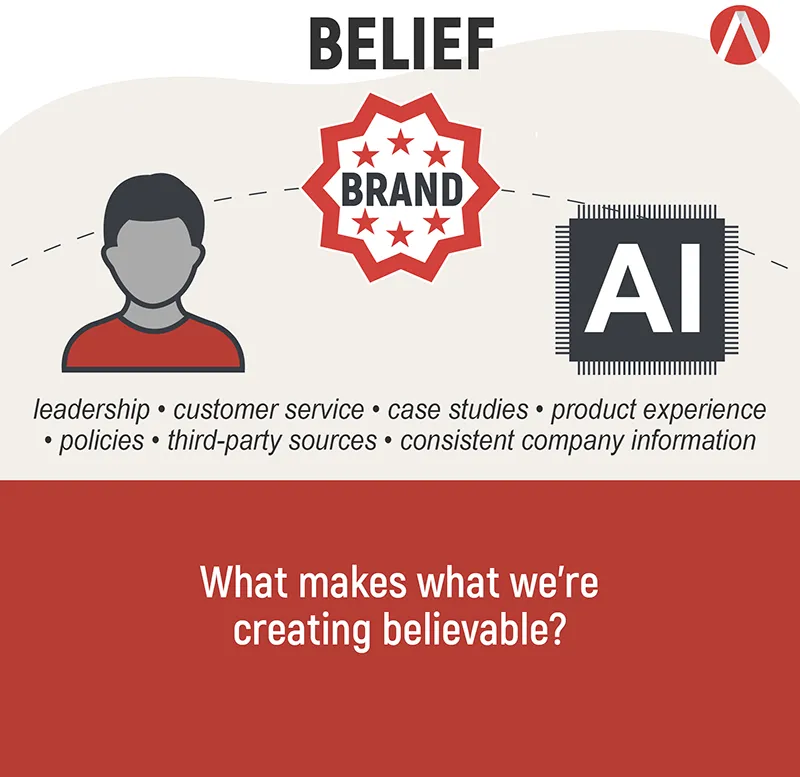
In other words, credibility increasingly cannot live in a founder’s voice or a single campaign. Your organization’s information, behavior, policies, customer experiences, and third-party signals need to reinforce one another.
That puts an interesting new spin on an old marketing challenge.
Don’t simply ask, “How can AI help us create more?”
Ask, “What makes what we’re creating believable?”
Marketing Can’t Manufacture Trust
There are five signals I believe every organization should examine; consistency, competence, transparency, proof, and humanity.
Do we behave consistently over time? Can we actually deliver what we promise? Do customers understand important decisions and why we make them? What evidence supports our claims? And can people see the human judgment and conviction behind the organization?
Marketing can communicate all five.
But marketing cannot manufacture them if they don’t exist.
Sometimes our job is to establish trust. Sometimes it’s to protect trust that has taken decades to build. Sometimes it’s to restore trust that has been lost or forgotten.
In every case, the organization creates the conditions. Marketing reveals the evidence and helps people understand why it matters.
That’s how awareness becomes trust. It’s how trust becomes belief. And ultimately, it’s how belief becomes action.
Questions to Ask Yourself
- What does our organization actually believe, beyond the words in our mission statement?
- Where can customers see evidence that those beliefs influence how we operate?
- If our founder or most visible executive disappeared tomorrow, would the belief remain?
- Are our customer experiences reinforcing our story or quietly contradicting it?
- Are we creating more information with AI, or stronger reasons for people to believe us?
If you’d like to explore this thinking further, listen to my latest StrategyCast episode 607, where I unpack the Trust Transfer, the Belief Path, and why building a brand worth believing in may be one of marketing’s greatest opportunities in the AI era.