

Key Takeaways
- The digital world produces millions of pieces of content every day, creating an environment where attention…not information…is scarce.
- In saturated markets, authority matters more than volume. Companies that shape industry conversations outperform those that simply contribute to them.
- Organizations build authority by offering distinct perspectives, interpreting complexity, and consistently sharing insights across influential platforms.
- Many companies already possess the expertise needed to lead their industries, but fail to translate internal knowledge into market influence.
- The brands that win in the next era of marketing will move beyond content creation and toward intellectual leadership.
For more than a decade, content marketing has been the cornerstone of modern marketing strategy. There was a steady drumbeat that told us we had to…
Publish insightful blogs.
Produce white papers.
Build a social media presence.
Launch a podcast.
The idea was…and still is…a good one. It’s also straightforward: create valuable information, and your audience will reward you with attention, trust, and ultimately business.
For a while, this formula worked extraordinarily well. In fact, companies that embraced content marketing early often saw dramatic increases in visibility and lead generation.
But success created a new challenge. Content marketing didn’t just grow; it exploded.
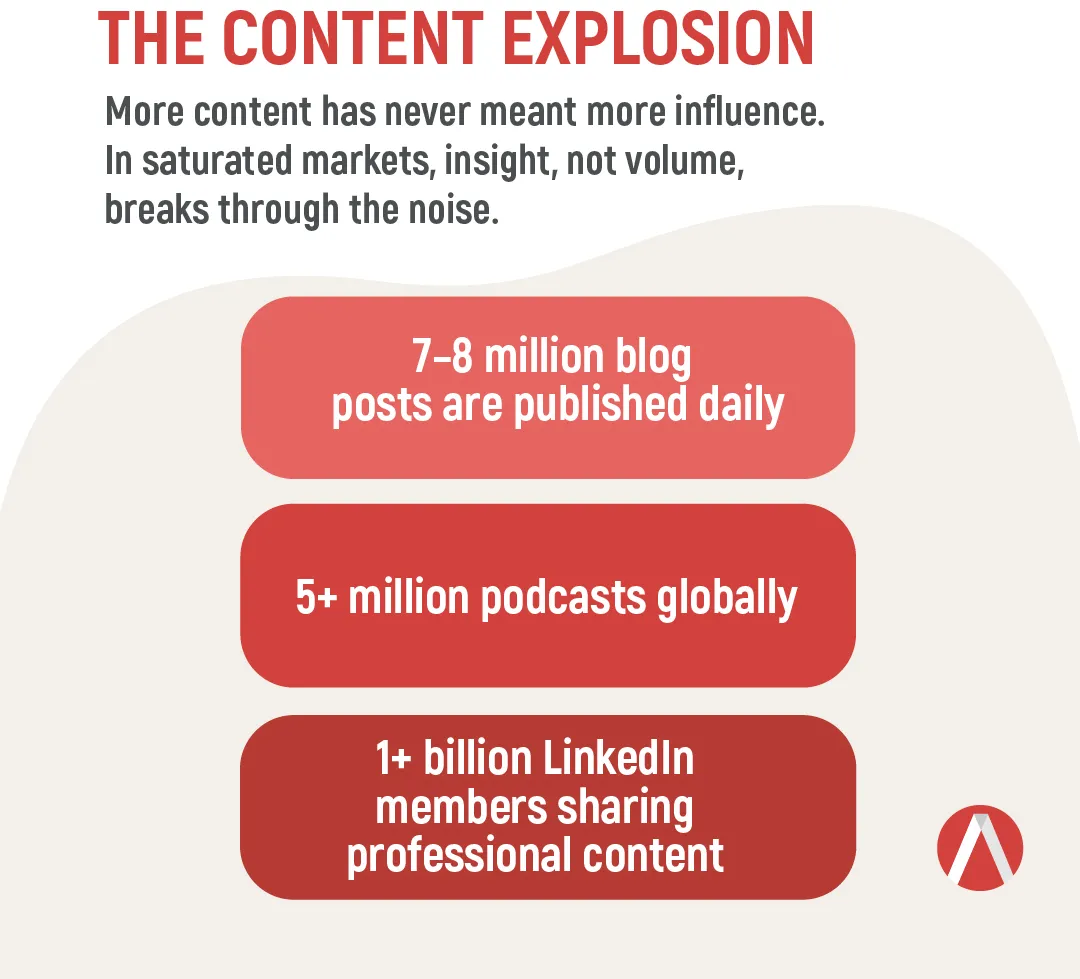
And with mindboggling numbers like that, the impact is equally as significant, because when information becomes abundant, something else becomes scarce: attention and trust.
That’s where the next phase of marketing begins.
Not with more content, but with authority.
The Content Explosion and the Attention Bottleneck
While the supply of content has grown exponentially, human attention has not.
Researchers and economists increasingly describe today’s digital landscape as an “attention economy,” where human focus has become a scarce and highly contested resource. In a world saturated with information, organizations aren’t just competing with their direct competitors; they’re competing with everything else trying to capture a moment of attention.
For executives and decision-makers already navigating overwhelming volumes of information, the result is simple: they filter aggressively. They gravitate toward organizations whose thinking they recognize and trust, voices that consistently provide clarity rather than noise.
In other words, the marketplace is no longer rewarding the companies that publish the most content.
It’s rewarding the companies that offer the most valuable perspective.
The Difference Between Content and Authority
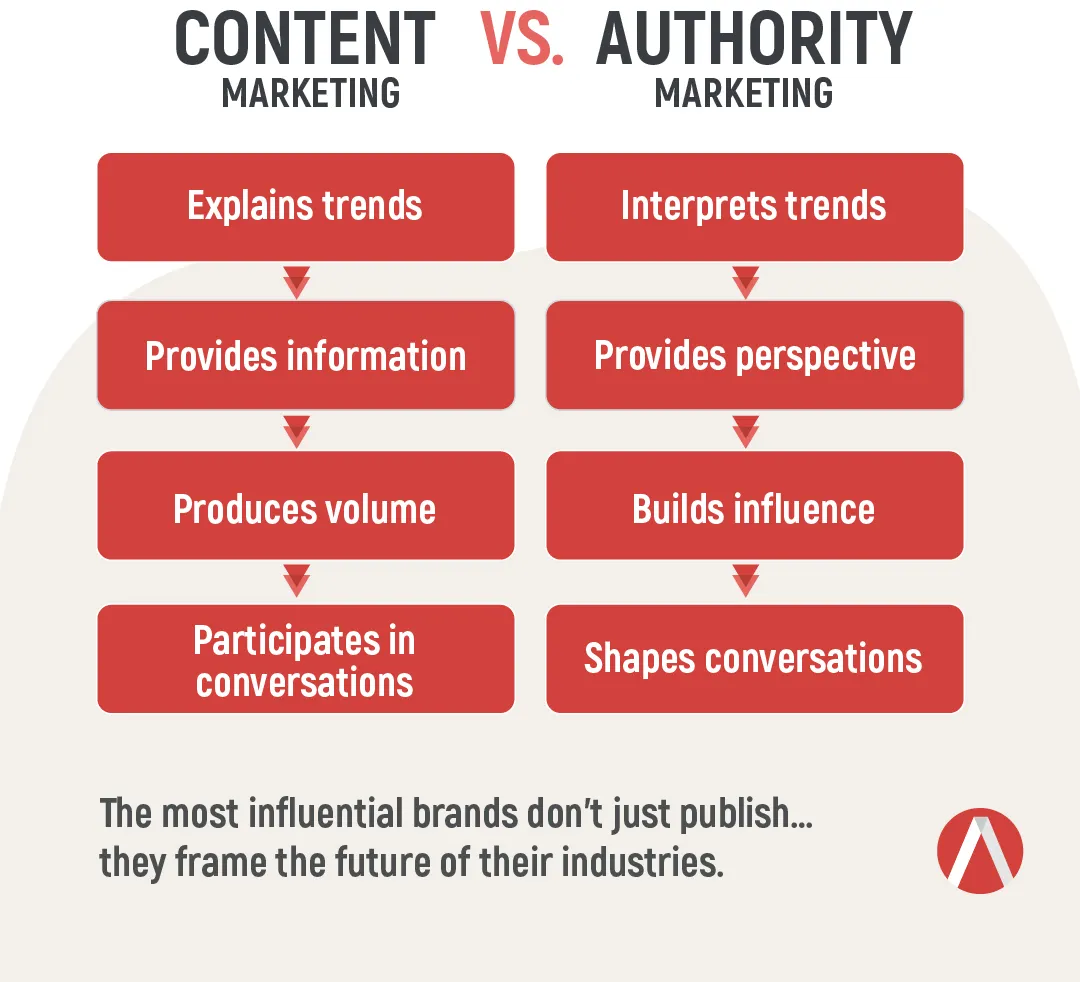
Content answers questions. Authority reframes them.
Many companies produce excellent content that explains trends, summarizes research, or provides helpful advice. But authority emerges when an organization goes further, when it interprets change and shapes how others think about it.
Consider how some companies have built enormous influence through ideas rather than advertising.
Salesforce didn’t simply promote its CRM platform. It helped define the broader movement toward cloud-based enterprise technology, changing how companies think about software infrastructure.
HubSpot didn’t just offer marketing tools. It articulated and evangelized the concept of inbound marketing, reshaping how businesses approach customer acquisition.
Similarly, consulting firms like McKinsey, Deloitte, and Bain have built decades of credibility not by producing generic content, but by publishing influential research and perspectives that help executives understand the forces transforming their industries. Through platforms such as the McKinsey Global Institute, Deloitte Insights, and Bain Insights, these firms regularly publish analysis that shapes how leaders think about economic shifts, technology disruption, and emerging business models.
Their content doesn’t merely inform. It frames the future.
And when a brand consistently provides that kind of perspective, the market begins to view it differently.
Not as a vendor. But as a voice of authority.
Authority Is Built on Insight, Not Output
Here’s what I know to be true: influence rarely grows through output alone.
It grows through clarity of thinking and depth of insight.
Organizations that successfully build authority tend to share three characteristics.
1. They bring a distinct point of view
Authority begins with perspective.
Companies that influence their industries rarely rely on safe, generic messaging. Instead, they articulate clear points of view about how markets are evolving, what challenges businesses will face next, and where opportunities are emerging.
This kind of perspective helps audiences interpret complexity, and it signals confidence in expertise.
2. They translate complexity into clarity
In today’s environment, decision-makers aren’t simply looking for information. They are looking for interpretation. Executives want help understanding:
- Which trends actually matter
- How technological change will reshape industries
- What strategic shifts companies should be considering
Organizations that can synthesize data, experience, and insight into clear narratives become invaluable guides in complex markets.
3. They show up consistently across influential platforms
Authority rarely develops in isolation.
It grows when a company’s perspective appears repeatedly across channels where industry conversations are happening: media coverage, podcasts, speaking engagements, executive commentary, and thought leadership content.
Over time, those consistent appearances reinforce credibility. The organization becomes associated with a particular kind of thinking.
The Hidden Opportunity Inside Most Organizations
Ironically, many companies already possess the intellectual capital required to build authority.
It exists in their leadership teams. In their experience with clients and markets. In the patterns they observe across industries. But that expertise often remains internal.
Engineers understand where technology is heading. Consultants see how industries are evolving. Executives recognize emerging challenges long before they appear in the news.
Yet those insights rarely leave internal strategy sessions or client conversations.
Organizations that successfully build authority recognize that ideas themselves are strategic assets.
They invest in capturing those insights, refining them, and bringing them into the broader market dialogue. And when they do, marketing shifts from simply communicating value to creating influence.
The Future of Marketing: Intellectual Leadership
The next era of marketing will not be defined by who publishes the most content. It will be defined by who contributes the most meaningful ideas. The organizations that rise above the noise will be those that:
- Develop clear perspectives on their industries
- Share those perspectives consistently
- Transform expertise into insight that helps others navigate change
In other words, they will move beyond content creation and toward intellectual leadership.
And in an environment defined by information overload, intellectual leadership may be the most valuable marketing currency of all.