

Key Takeaways:
- The CMO role has evolved from communications steward to growth architect.
- Marketing now directly influences revenue strategy, data alignment, and customer experience.
- Performance marketing without positioning creates short-term lift but long-term vulnerability.
- CEOs must recalibrate expectations of what modern marketing leadership looks like.
- Alignment between CEO, CMO, and CRO determines growth velocity.
There was a time when marketing sat at the end of the table. It owned messaging. Managed campaigns. Oversaw brand and communications. Important work, but contained.
That time is over.
In today’s enterprise environment, marketing does not just communicate growth strategy. It shapes it. And yet, in many organizations, expectations of the CMO haven’t kept pace with reality.
From Communications Steward to Growth Architect
The modern CMO influences far more than awareness. Marketing now intersects with:
- Revenue modeling
- Data strategy and attribution
- Customer journey architecture
- Product positioning
- Sales enablement
- Talent recruitment
- Category definition
In many companies, marketing is the only function that has a full view of the buyer lifecycle, from first touch to renewal and advocacy. That vantage point makes it uniquely powerful. But only if leadership recognizes it.

The Performance vs. Positioning Tension
One of the biggest pressures facing marketing leaders today is the performance trap.
Boards want measurable ROI. Investors want a predictable pipeline. Revenue teams want leads.
All reasonable.
But when marketing is reduced to demand generation alone, something critical erodes: positioning.
Performance marketing can optimize what exists. Strategic marketing defines what the company stands for. Without positioning, performance becomes expensive. Without clarity, campaigns compete on cost instead of conviction. The strongest growth organizations understand this balance. They fund both the engine and the architecture.
What CEOs Should Expect from a Modern CMO
If marketing is still treated as a service function, growth will plateau. Today’s CEOs should expect their marketing leader to:
- Shape market narrative
- Inform revenue strategy
- Translate customer data into positioning insight
- Align brand and sales strategy
- Identify whitespace opportunities in the category
In other words: strategic leadership. Not just campaign execution. A CMO who isn’t invited into enterprise-level decisions can’t influence enterprise-level outcomes.
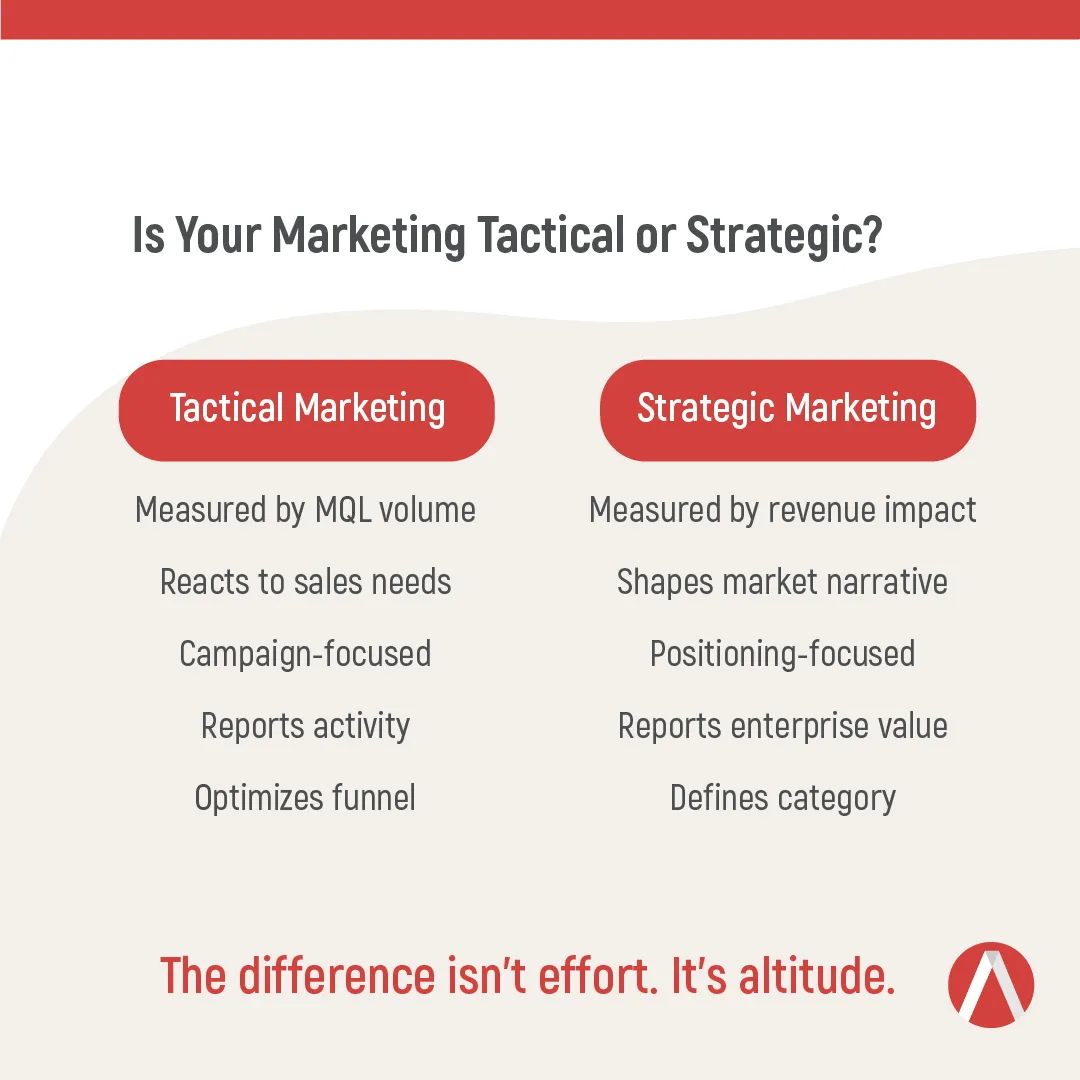
Tactical vs. Strategic Marketing: The Warning Signs
Here’s how you know marketing is operating tactically:
- It is measured solely on MQL volume.
- It reacts to sales requests instead of informing them.
- It produces assets without shaping positioning.
- It reports on activity, not enterprise impact.
Strategic marketing, by contrast:
- Drives narrative alignment across the organization.
- Influences pricing confidence.
- Sharpens the ideal customer definition.
- Aligns brand, demand, and customer experience.
The difference isn’t effort. It’s altitude.
The CEO–CMO–CRO Growth Equation
Growth velocity today is less about isolated departmental performance and more about executive alignment.
When the CEO defines ambition…
The CMO defines market positioning…
And the CRO operationalizes revenue strategy…
Momentum accelerates. When those three roles operate in silos, friction replaces flow.
Misalignment between marketing and sales doesn’t just slow the pipeline, it weakens enterprise credibility in the market. Alignment compounds. Disconnection dilutes.
Marketing as an Enterprise Growth Function
The organizations pulling ahead right now are not those with the loudest campaigns. They are the ones where marketing sits at the strategy table, shaping narrative, informing revenue modeling, and guiding customer experience design. Marketing is no longer a support function. It is a growth function. And growth functions require authority.
The question for leadership teams is not: “Is marketing performing?”
It’s: “Is marketing architecting our future?”
Because companies that treat marketing as a department will grow incrementally. Companies that treat it as an enterprise growth engine will define their categories. And that difference determines trajectory.