

Key Takeaways:
- The biggest competitive risk in 2026 isn’t failure, it’s invisibility.
- “Pretty good” strategies create margin compression, brand confusion, and talent drift. When a company chooses clarity, it doesn’t just sharpen its market position, it sharpens internal confidence.
- Consensus-driven positioning often weakens differentiation.
- Market leaders are rarely safer, they’re clearer and bolder.
- Moving out of the middle requires executive conviction, not incremental tweaks.
I’ve sat in enough boardrooms to recognize the pattern.
Revenue is steady. Not extraordinary, but stable. Brand perception is solid. Not iconic, but respectable. Marketing is producing. Sales is pushing. Operations are operating.
No fires. No headlines. No dramatic swings. Everything is… pretty good. And that’s exactly when I start to worry. Because the middle is not neutral territory. It’s erosion.
The Illusion of Safety
For decades, companies believed stability equaled security. But we’re operating in a different economy now, one defined by velocity, noise, and constant comparison.
Consider this: In crowded B2B markets, buyers evaluate multiple vendors…often three to five…and spend surprisingly little time with each. Research from Gartner and 6sense shows that perceived differentiation frequently outweighs price in final selection decisions.
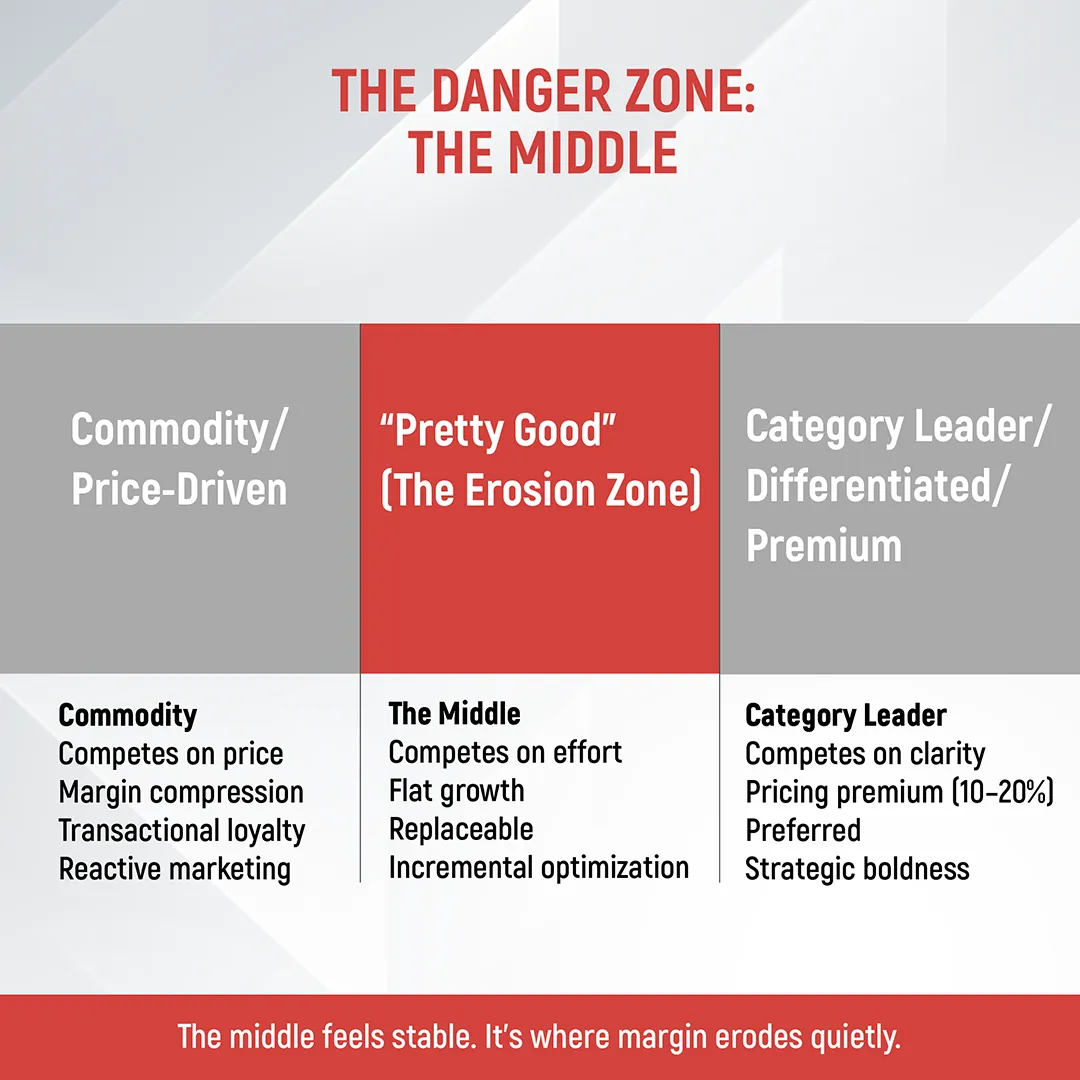
And the financial implications are real. McKinsey has found that strong brands can generate up to twice the shareholder return of weaker competitors, while category leaders sustain pricing premiums of 10–20%.
The middle doesn’t just feel safe; it is safe. But it costs you margin. When you live in the middle, you compete on effort. When you lead, you compete on clarity. There’s a difference.
Consensus Is Not a Strategy
One of the biggest culprits of “pretty good” positioning? Consensus. I’ve watched leadership teams workshop messaging until every sharp edge is sanded down.
“We don’t want to alienate anyone.”
“Let’s soften that.”
“Can we make it broader?”
Of course, we can make it broader. But in doing so, we make it blander.
Strong positioning feels risky internally before it feels powerful externally. It requires saying, “We are for this, and not for that.” That tension is healthy. It signals distinction and differentiation.
But consensus-driven cultures often reward safety over strength. But that results in something no marketer wants: messaging that could belong to anyone in the category.
And when you sound like everyone else, you become optional.
The Financial Cost of the Middle
This isn’t just a branding conversation. It’s a balance sheet issue.
Companies stuck in the middle experience:
- Margin pressure because price becomes the differentiator.
- Longer sales cycles because buyers struggle to articulate why they should choose you.
- Talent attrition because high performers want to work for leaders, not followers.
- Marketing inefficiency because more spend is required to achieve the same impact.
“Pretty good” is expensive. And it compounds quietly.
A Tale of Two Growth Curves
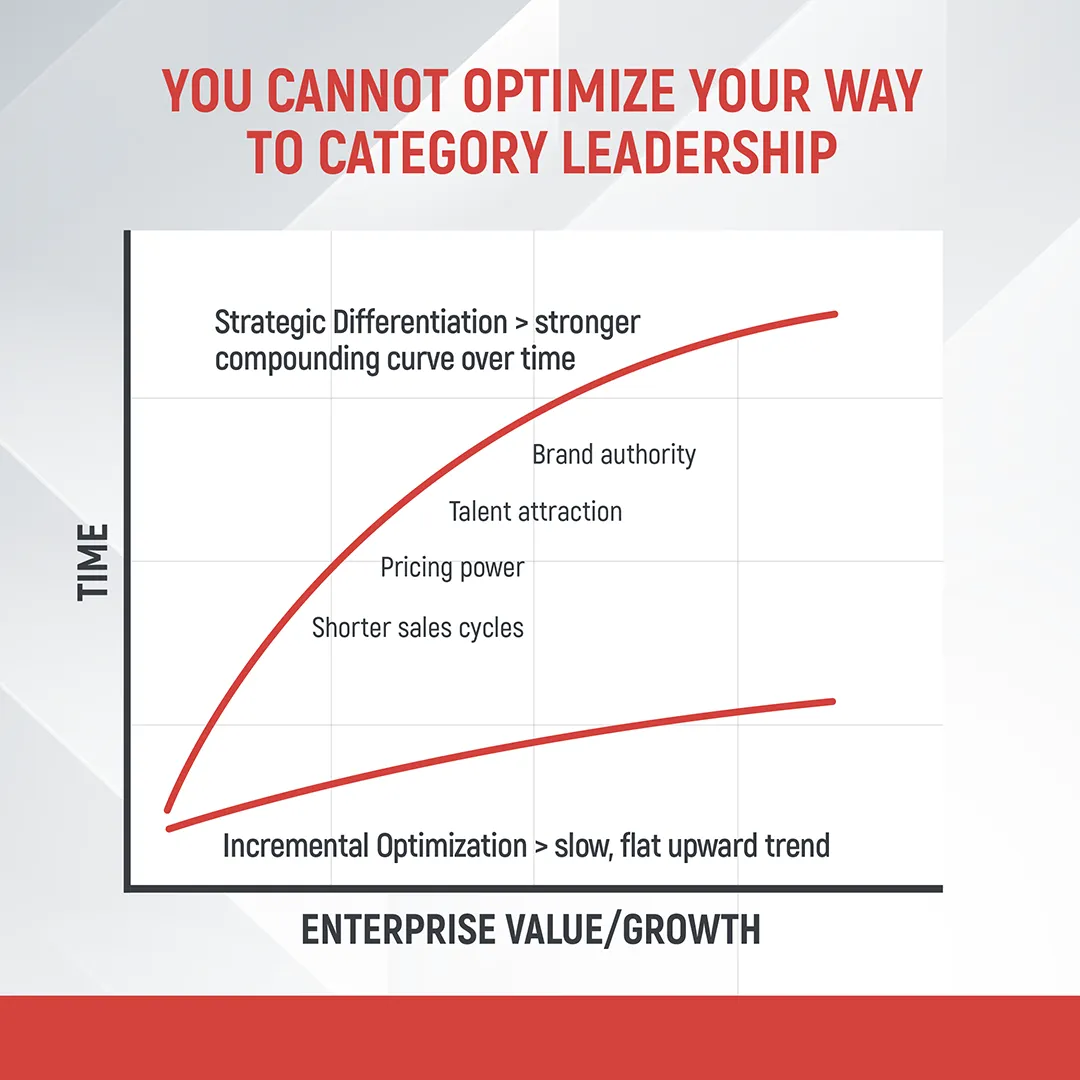
We’ve worked with organizations in similar industries, at similar revenue levels, with similar resources, but dramatically different outcomes.
One chose incremental optimization: Tighten the funnel. Adjust messaging slightly. Improve campaign performance by 3–5%.
Respectable improvements.
The other chose bold clarity: Refined its positioning. Reframed its category narrative. Elevated executive visibility. Drew sharper lines around its ideal customer.
That second organization didn’t just see lift in marketing metrics. It saw:
- Stronger inbound quality
- Shorter sales conversations
- Increased confidence across the executive team
- A cultural shift from defensive to decisive
The external clarity created internal alignment. That’s what leaving the middle looks like.
The Psychological Trap
Here’s the uncomfortable truth: the middle feels responsible. It feels measured. Disciplined. Prudent. Boards like predictability. Investors like stability. Teams like clarity. But what they really need is conviction.
The market does not reward “responsible.” It rewards memorable. And memorability requires risk, not reckless risk, but strategic boldness. Or put it another way: you cannot optimize your way to category leadership.
Signs You’re Drifting Toward the Middle
If you’re a CEO or CMO, here are a few questions I encourage you to wrestle with:
- If we removed our logo, could our messaging belong to a competitor?
- Are we leading conversations in our industry, or reacting to them?
- Does our pricing reflect confidence or competition?
- Are we attracting top-tier talent because of who we are, or in spite of it?
- Would our customers describe us as distinctive?
If those answers feel murky, you may be sitting in the most dangerous place in business.
How to Move Out of the Middle
This isn’t about being louder. It’s about being clearer. It starts with leadership alignment around three things:
- Who we are uniquely built to serve.
- What we are willing to be known for.
- What we are willing to stop saying and stop doing.
Notice that third one?
Bold strategy requires subtraction. It requires saying no to comfortable sameness. It requires deciding that “pretty good” is not your aspiration.
The Real Risk
The greatest strategic risk in 2026 isn’t a bold move that fails. It’s slow invisibility.
It’s margin compression disguised as market pressure. It’s declining differentiation masked by incremental improvement. It’s talent quietly migrating to companies with sharper identities.
The middle doesn’t feel dramatic. It feels stable.
Until it isn’t.
And by the time you feel the erosion, competitors have already claimed the high ground.
The question I leave you with is simple: Are you building a company that is safely comparable…or unmistakably clear? Because the market doesn’t reward the middle. It replaces it.
Because in today’s market, the space between those two outcomes is where growth either compounds… or disappears.